History of our Church
The ground on which the building of St Oswald stands has been consecrated as a place of worship since before 1180. When Uctred was appointed to serve here in 1200 he became the first in a long line of priests that has continued to this day.
Aysgarth Church was Mother Church of the district and Askrigg was a chapel-of-ease covering the whole area from a little west of the Aysgarth to the dale head. Eventually, from about the 15th century, as the population expanded, further parishes were created at Hawes, Hardraw, Lunds and Stalling Busk. When the dale’s population began to decline from the 19th century, the reverse happened as parishes were conjoined: Hardraw and Lunds (1858); Askrigg and Stalling Busk (1930); Hawes and Hardraw (1953).
The small parish church of St Matthew’s at Stalling Busk is situated on the hill overlooking Semerwater. It was built in 1909 and at that time was very innovative as it is a beautiful example of Art Nouveau architecture with lovely stained glass windows. It is well worth a visit.
Prior to the building of St Oswald’s Church, there was a religious presence in the area. Local tradition suggests that an area at the east of the village, known as Kirk Close, had a preaching cross called St Oswald’s and perhaps a Saxon church. If there was no church building the spiritual needs of local folk were met by travelling monks who preached beside the cross and baptised people. Evidence shows that in 1145 Cistercian monks established Fors Abbey, a wooden building at Dale Grange, a mile west of Askrigg. However, the climate was too harsh so the abbey was abandoned and the monks moved to Jervaulx c15 miles east of Askrigg. The Cistercians continued to own extensive estates in the dale and took tithes (a tenth of all produce) from their Askrigg lands.
The monasteries were dissolved in 1539 and later Queen Mary gave the tithes to Trinity College, Cambridge. From that time, therefore, the labour of the dale’s hill farmer contributed to the glorious buildings and the scholarship of Trinity College. Trinity appointed the priest at Aysgarth (and still does) and Aysgarth in turn found and appointed a priest at Askrigg.
The present building of St Oswald dates from about 1446 with the nave and south aisle being in the Late Early-English and Perpendicular styles. The main glory is the nave ceiling with its beautiful beams, said by Pevsner to be the finest in the North Riding. The north aisle was added slightly later and because the arches do not fit the piers which are in the round Norman style, an unlikely tradition has been perpetuated that the round piers came from a monk’s chapel at Fors Abbey. The south aisle was rebuilt in a restoration about 1770. The whole church underwent a disastrous and extensive restoration in 1853. Changes included replacing the simple windows with a mock gothic style and adding many furnishings. Fortunately, the basic shape was not touched, neither were the fine proportions spoilt.
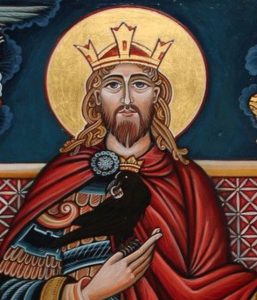 Our church is dedicated to St Oswald and visitors often ask just who Oswald was and about his connection to this area.
OSWALD was born around 604 to Ǣthelfrith Iding, the king of Bernicia and Deira and his wife, Acha Yffling, the daughter of Ǣlle, who was King of Deira at the time of her birth. Oswald was their oldest child, born a year or so after their marriage. Ǣthelfrith was one of the greatest early medieval warlords and he died in battle when Oswald was in his early teens. Acha had at least six sons and a daughter.
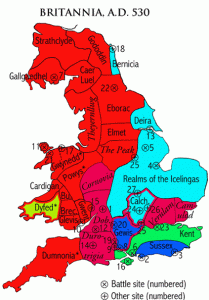
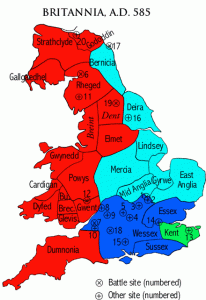
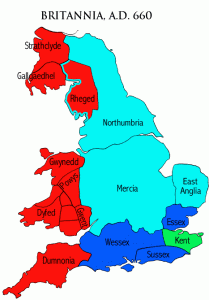
Britannia before and after Oswald’s reign
Oswald Iding ruled Northumbria for 8 years from 634-642. During this period, he was recognised as the ruler of most of the kingdoms of Britain – including Mercia, East Anglia and Wessex. He was undoubtedly a fine warrior in the mould of his father, and he was the first English king to die a Christian martyr. He is often described as an exiled prince whose destiny was to return home to reclaim his birth right. Oswald’s historical significance is greater than nearly all before or since. He forged cultural links with all parts of Britain, which gave rise to an age of arts and language, the foundation of the monastery on Lindisfarne and his political legacy could be said to include the crusades. Interestingly, JRR Tolkien based Aragorn, in his fantasy novel, Lord of the Rings, on Oswald.
Oswald was born probably at Gefrin (Yeavering), the ancestral summer hillfort palace of the ruling Iding family in today’s Northumberland. We don’t know much about his early years, but what we do know begins around 616AD.
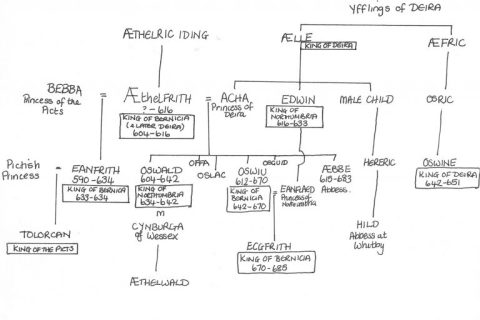
Ǣthelfrith was killed in battle by Rǣdwald of East Anglia around 616 and in those days there was no automatic right for a son to inherit a kingdom, especially if they were a child. Edwin, Oswald’s uncle, was crowned king and his sister, Ache, mother of Oswald, gathered up her children and fled to her husband’s Scottish allies, the Dal Riata tribe. A small boat transported 12 year old Oswald, his younger brother Oswiu, who would one day succeed him, and his baby sister Æbbe (a future abbess of Coldstream). Oswald’s other brothers are likely to have been with them and possibly Acha herself, but no records exists of them. The family went to Iona, were taken in by the monks and received an education befitting their royal status. Oswald remained on Iona until he was 30; transforming from a heathen English child refugee into a crusading Christian prince.
Following Edwin’s own death in 632 in battle against Cadwallon of Gwynedd and Penda of Mercia at the battle of Hatfield Chase in Nottinghamshire, Oswald began his journey home to claim his kingdom. It was almost a year before Oswald was in a position to challenge Cadwallon and during that time Cadwallon and his troops had laid waste to Northumbria. Oswald brought with him an army of Scottish and Ionian warriors, a contingent of Pictish warriors sent by his half brother’s family and had also gathered supporters on the march south. The night before the battle, Oswald’s army were camped on the banks of the river Denisburn and the odds were overwhelmingly against them. As night fell, Oswald looked up at the stars and took comfort from the sight. As he did so, a dream-like figure came down to him and told him that God had promised him victory. Oswald thought that the figure had been St Columba.
Ǣthelfrith was killed in battle by Rǣdwald of East Anglia around 616 and in those days there was no automatic right for a son to inherit a kingdom, especially if they were a child. Edwin, Oswald’s uncle, was crowned king and his sister, Ache, mother of Oswald, gathered up her children and fled to her husband’s Scottish allies, the Dal Riata tribe. A small boat transported 12 year old Oswald, his younger brother Oswiu, who would one day succeed him, and his baby sister Æbbe (a future abbess of Coldstream). Oswald’s other brothers are likely to have been with them and possibly Acha herself, but no records exists of them. The family went to Iona, were taken in by the monks and received an education befitting their royal status. Oswald remained on Iona until he was 30; transforming from a heathen English child refugee into a crusading Christian prince.
Following Edwin’s own death in 632 in battle against Cadwallon of Gwynedd and Penda of Mercia at the battle of Hatfield Chase in Nottinghamshire, Oswald began his journey home to claim his kingdom. It was almost a year before Oswald was in a position to challenge Cadwallon and during that time Cadwallon and his troops had laid waste to Northumbria. Oswald brought with him an army of Scottish and Ionian warriors, a contingent of Pictish warriors sent by his half brother’s family and had also gathered supporters on the march south. The night before the battle, Oswald’s army were camped on the banks of the river Denisburn and the odds were overwhelmingly against them. As night fell, Oswald looked up at the stars and took comfort from the sight. As he did so, a dream-like figure came down to him and told him that God had promised him victory. Oswald thought that the figure had been St Columba.
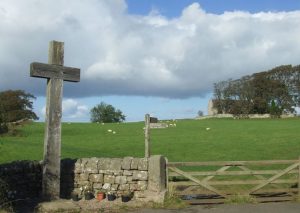 Oswald woke his men and together they fashioned a cross from two long pieces of wood and when it was finished, they dug a hole and placed the cross upright, stamping around it until the cross was secure. The dawn broke and a shaft of sunlight fell on the cross. Oswald dropped to his knees and encouraged his army to kneel and pray that ‘the true and living God would defend us from this cruel and fierce enemy’.
Once they had finished praying the army rushed to meet their enemy. The battle was long, but Cadwallon was slain and Oswald had won. The place was renamed Heavenfield.
Oswald was now king of Northumbria, but the land was in misery, poverty and hunger having had no government or law enforcement for a year and no churches or clergy, remaining a pagan kingdom. Oswald looked to his former home and sent to Iona, asking the Abbot to send him a Bishop to help with the reconstruction of his Northumbria. They sent Aidan, a young Irishman, whom Oswald will have known from his time in Iona. Oswald gave Lindisfarne for his base.
From that time onwards these two worked together for Christ and the people; often working at Oswald’s power base at Bebbanburg, which stood on what is now known Bamburgh Head. Babbanburg had long been associated with the Bernicians. Æthelfrith had given the settlement to his first wife Bebba, a pictish princess, and it had been renamed Bebbanburg – the settlement of Queen Bebba.
Oswald built churches and gave his wealth and lands to found monasteries. Aidan baptised, preached and ordained priests. Aidan was Irish by birth and did not know the English language. When he preached at the king’s court, Oswald himself translated.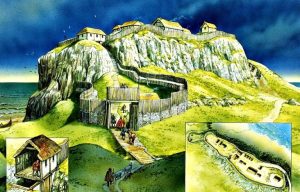
Oswald’s good works were not confined to his own lands. He developed many alliances and good relations with other kingdoms, acting as godfather when the pagan king of Wessex was baptised into the church. Deira and Bernica, the two parts of Northumberland were made into one kingdom. Oswald was showing a new kind of kingship – a brave warrior, but also a wise ruler and a kind father to his people. He was always courteous and affable with the poor and sick. Despite being king, Oswald was never seduced by the power and continued to live a life of prayer and self-denial.
One Easter day, when Oswald was having dinner with Aidan, a silver platter of delicacies was put in front of them. Oswald had just asked Aidan to say grace, when a servant came in and told Oswald that there were a great number of poor people outside asking for alms. Oswald looked down at the platter full of meat and told the servant to take it out to them and then to cut the platter into pieces and distribute it amongst them. Aidan, watching this, was full of joy at Oswald’s kind heart. He took hold of Oswald’s right hand and said, ‘May this hand never grow old’.
Oswald married Cyniburh, the daughter of an ally, King Cynegisl of Wessex in 635. Their reign saw increasing prosperity and growth in Northumbria. However, 8 years into his reign, Penda, the heathen king of Mercia fought and killed the Christian king of East Anglia; and Oswald gathered his army and marched to rescue the conquered people from Penda.
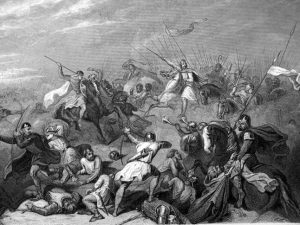 Oswald drove Penda back to the Welsh border, and a great battle was fought on 5 August 642, known as the Battle of Maserfelth. This battle did not go well and his faithful warriors fell one by one at his side. Oswald knew that the battle was lost and prayed to God for the souls of all the soldiers who had died that day, of whatever side.
He was cut down by the marauding army and a great shout went up when they knew they had killed the king. Penda had no respect for Oswald and cut off each of his limbs and put them on spikes. This place became known as ‘Oswald’s Tree’, nowadays we know it better as Oswestry. The place where Oswald’s body had fallen became holy ground and people kept taking handfuls of soil away, until there was a deep crater!
Oswald’s kingdom was split after his death; although he had a son, he was still a young child and so he was succeeded by his brother Oswiu, who ruled Bernicia and by Oswine (a distant cousin) in Deira . Once Oswiu had secured Deira, he set out for Oswestry and brought Oswald’s remains back to Bamburgh. They were interred in a silver casket.
Miracles began to be associated with both the site of Oswald’s death and the site of his interred remains. It was said that Aidan’s words had become true and his right hand remained as it had in life and it became a site of pilgrimage from as early as 643.
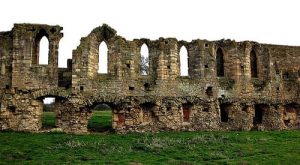 Oswald’s remains were moved to Bardney Abbey in Lindsey by Oswald’s niece Osthryth. When Bardney became Viking territory in the early 10th century, Ǣthelflǣd, daughter of Alfred the Great, carried out a raid on the Abbey and removed Oswald’s remains to Gloucester, in a new minster named St Oswald’s priory to honour his memory where Ǣthelflǣd and her husband would later be buried.
Oswald’s head is said to be in Durham cathedral, alongside that of Cuthbert; but there is no proof of this, and as with other saints, many churches claim to have parts of Oswald’s body, including some overseas. Peterborough Cathedral has a chapel dedicated to Oswald, which was said to house his arm during the Middle Ages.
Oswald was made a saint in the early medieval period, but the exact date is not known. His exploits are recorded in many historic documents, including those by the Venerable Bede.
As well as many churches in the North bearing Oswald’s name, including our own, there are other places such as Oswaldtwistle in Lancashire, and Kirkoswald in Cumbria, which are believed to have been named after places were Oswald’s body was taken after his death on his journey back to Bebbanburg.
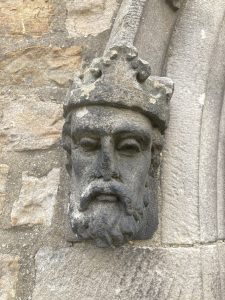 A church was built at Heavenfield shortly after the battle and Anglo-Saxon church was replaced with a Norman building, which stands today, close to a replica of the cross erected by Oswald on the eve of the battle. We do not know when our church was dedicated to St Oswald. It is possible that the Saxon church which predated our current church was dedicated already dedicated to St Oswald. Stone images of Oswald and his queen, Cyniburh, appear on the outside of the church on either side of the south door.
Further Reading:
Max Adams: The King of the North, the life & times of Oswald of Northumbria 2013
Bede: Historia Ecclesiastica gentis anglorum 731
Our War Graves
WWI
William was born at Dykes Head, Gunnerside in Swaledale in 1896. He was the son of George Appleton and Margaret (nee Coates). From a farming family, William was the third youngest of five sons and two daughters and by the start of the war he was working in the Askrigg district, and he enlisted in the army in Leyburn.
William joined the 9th Battalion, Durham Light Infantry (Gateshead Gurkhas). On 5th November 1916, the battalion was on the Somme near Warlencourt village ready to attack the Butte de Warlencourt, a 40-foot-high conic shaped hill with a quarry in front of it. Initially, they found success as they moved over and round the butte and broke into the German lines beyond. The heavily reinforced enemy counterattacked just after 3:00pm and the battalion was gradually forced back. Desperate hand to hand fighting took place during the afternoon resulting in heavy losses on both sides.
After four hours of sustained bombardment, a final counterattack was launched against the Durhams at 11:00pm. The men of the 9th battalion were overwhelmed, and many died fighting. Others were compelled to surrender and only a handful of men found their way back to the British lines.
Forty-two men were killed that day, 230 wounded and 157 posted missing. One of those missing soldiers was William. He had been wounded in the fighting and had been captured. Nursed by the Germans behind their lines, he died from wounds on 25th January 1917 and was buried by the Germans in grave 1 VC9 in Valenciennes (Saint Roch) Communal Cemetery in France. The cemetery was in German hands throughout the war, and they used it to bury their own dead. William is one of 348 British soldiers also buried there by the Germans.
When word reached the Appleton family, they must have been overwhelmed. William’s older brother, George, had died less than 4 weeks earlier at home in Swaledale and the family were already grieving deeply.
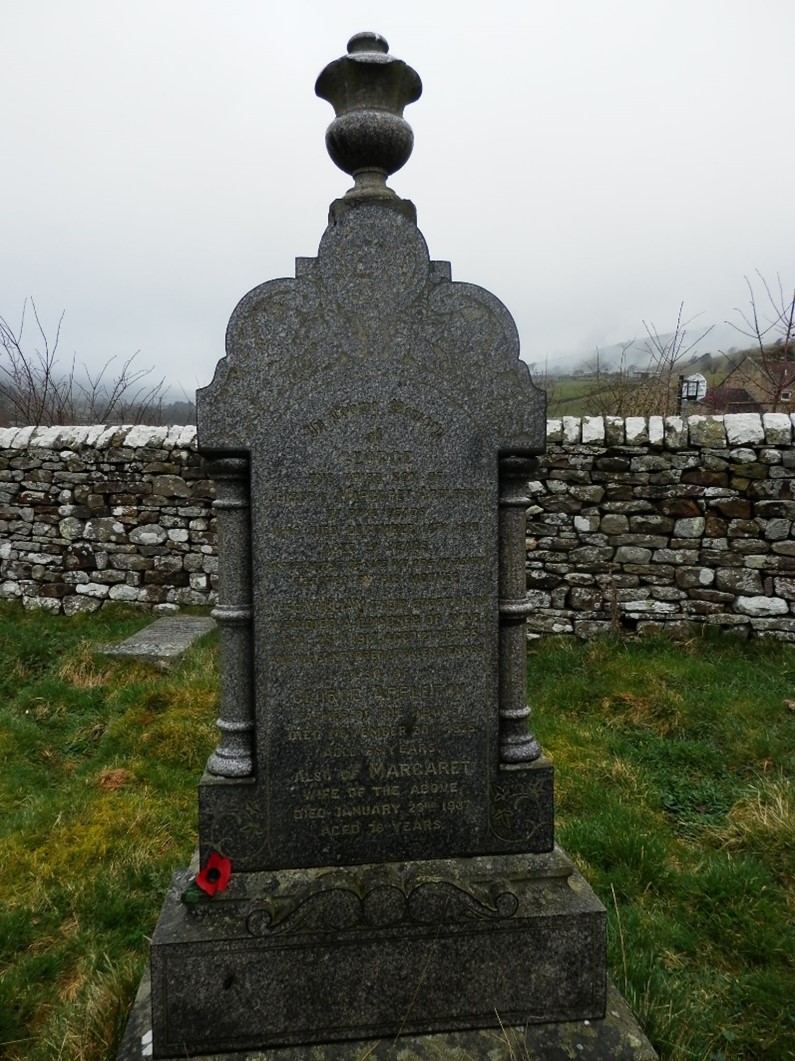
George was laid to rest in Gunnerside Wesleyan Church cemetery, and William and their parents are also remembered on the memorial stone.
William eldest sister Jane (1885-1975) married farmer William Thwaites and other sister, Margaret Ann (1903-1990) married John Reynoldson, a builder and stone mason and the couple lived in Thwaite.
His brothers, James (1889-1928), John (1890-1945) and Albert (1898-1965) all worked in farming and married Louisa Metcalfe, Ethel Dinsdale and Mary Rudkin respectively.
William Banks (senior) married Margaret Annie Bell at St Oswald’s on 1st September 1895 and the couple set up home in Askrigg. The couple had six children, George, William, Alice, Fred, Peggy (Sarah Margaret) and John. William was in business as a grocer and supplier of cattle feed. They had a shop, with a warehouse attached, where their horse and cart were stored.
Both William junior and his elder brother George enlisted in the army. William enlisted i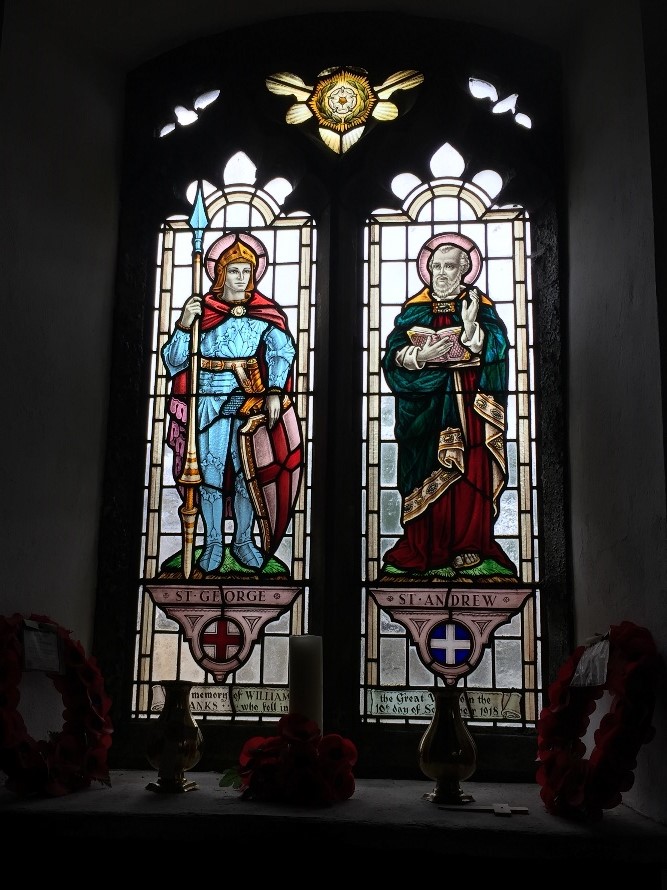 n Richmond and joined the 1st Battalion East Yorkshire Regiment. His brother was in the Northumberland Fusiliers.
In September 1918, William’s battalion found themselves taking part in the early stages of the ‘Advance to Victory’. On 10th September they were at Sorel, near Gouzeaucourt, which is between Peronne and Cambrai, ready to attack a series of enemy trenches. The bombardment was delayed, and, in the darkness, the companies found themselves out of position. The attack went in a northerly direction rather than to the northeast. The Germans had anticipated the attack and was fully prepared to meet it. The company on the right met with heavy machine gun fire, and as they had lost their supporting barrage, had to withdraw. The left company went too far left, and the enemy counterattacked and captured 20 men. In addition, one officer and 5 men were killed, and two officers and 36 men were missing. William was one of the dead and his body was buried in grave I.V.D.2 in Gouzeaucourt New British Cemetery. The stained-glass window closest to the main South Door of our church is a memorial to William.
William’s brothers George (1896-1959) and John (1911-1969) worked with their father in the family business. George married Rose Fawcett in 1927 and they lived with their children in Askrigg. Alice Jane (1901-1985) married Henry Russell in 1927 and moved away. Peggy (1908-1981) never married and remained in Askrigg. Fred was born in 1904 and baptised here on 1st May that year. John, born in 1911, is recorded in the 1939 census as being a partner in the business with his father and a special constable.
James Chapman was the son of Alexander Chapman, a Bainbridge farmer and his wife Mary Wood, who was born in Turton, Lancashire. James was born in 1895 in a farmhouse at Borwins, a cluster of farmsteads near the river Ure between Bainbridge and Hawes. He was baptised in St Oswald’s church on 15th August 1897. By the 1901 census, James was living with his sisters, Elizabeth and Violet and his parents in Sunny Dene in Bainbridge and later that year another sibling, Charles Alexander was born.
James left his family to seek a career in Manchester and at the outbreak of the war in 1914 he was in the employ of Messrs Bagley and Chapman, meat wholesalers. He enlisted in November 1915 and was posted to the Manchester Regiment. He was sent to France in May 1916.
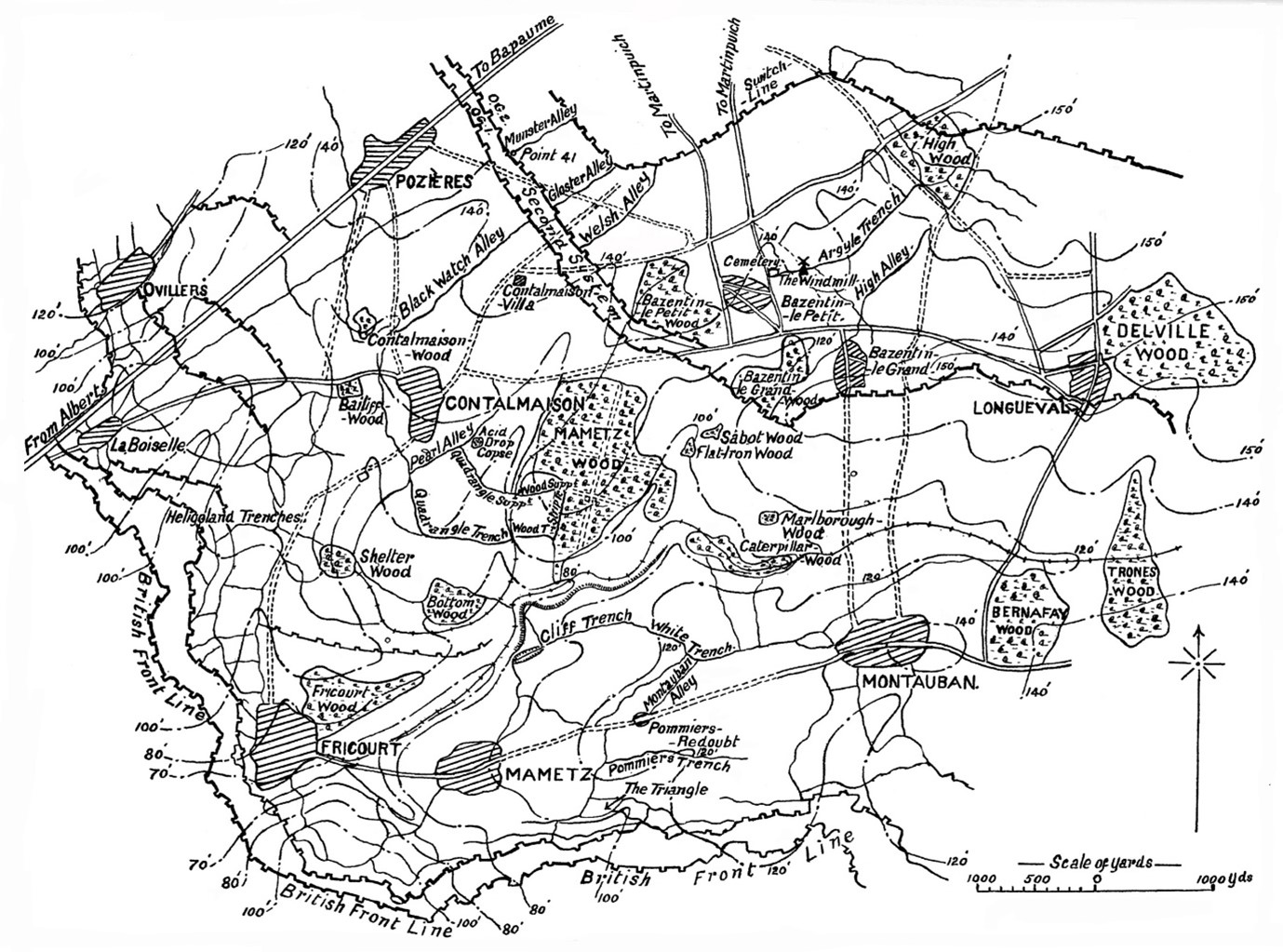
The objective of the Battalion was the capture of the village of Mametz and it was ultimately successful in achieving this aim. However, they had come under very heavy machine gun fire from the entrenched German soldiers and many of the surviving soldiers described the battle for Mametz as a ‘vision of hell’. Amongst the many casualties was James, struck down in the frightening hail of bullets and shellfire on 1st July, less than 6 weeks after he left England. His body was never recovered, and he is commemorated on the Thiepval Memorial on the Somme.
James was the first soldier in the parish to have died in the conflict. At the end of July, a large congregation of attended a memorial service at St. Oswald’s Church led by Rev Squibb.
Back at home, Alexander and Mary died in 1935 and 1930 respectively. James’ brother Charles had taken over his uncle James’ business as a grocer and dealer and in the 1939 census he was living in Bainbridge with both his sisters who remained unmarried. Charles died later that year on 4th November aged just 38. Elizabeth (1890-1954) married garage proprietor Herbert Callender in 1942 and Violet (1898-1956) married local stone mason John Outhwaite Metcalfe in 1949.
Frank was born at Litherskew, a small farming settlement close to Sedbusk in High Abbotside. His father, James, was a farmer and he had married Sarah Thornborrow from Brough in Westmoreland in 1876. Frank was one of their 15 children, some who were older and some who were younger.
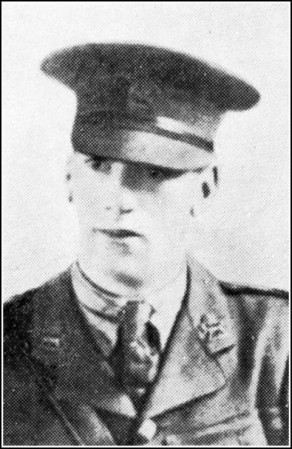 Frank was not destined for a farming life and after leaving Yorebridge Grammar School he attended Garforth college and then Leeds University. By this time his family were now farming at Shaw Cote. When WW1 broke out Frank was a member of the Leeds University Officer Training Corps, receiving his Commission in September 1915 with the rank of second Lieutenant, the 12th battalion York and Lancaster regiment. He went out to France in June 1916.
On June the 5th the battalion moved to Gezaincourt, where they practised assembling in the trenches ready for the forthcoming engagement. At 9:00pm on 30th June they marched to assembly trenches near Courcelles, where tea was issued to the men. The battalion was no sooner in position opposite the German positions when the enemy bombardment began with great violence and casualties mounted. At 7:30am the following morning the company moved forward and lay down about 100 yards in front of the trenches undercover of their own bombardment, but with the enemy shellfire landing amongst them.
The first and second waves moved forward to the assault and were met at once with severe shell, rifle and machine gunfire; the left half of C company being wiped out before reaching the enemy wire. The battalion third and fourth waves suffered so heavily that by the time they had reached No Man's Land they had lost half their numbers. The failure of the attack was wholly due to the wire being insufficiently cut.
One of those reported missing, believed wounded, was Frank but it was not until much later that his parents received official notification that their son was presumed killed. The interval of time brought much suffering to his family. Frank's grave was only found on 13th November, at the very end of the battle when the village of Serre, one of the uncaptured first day objectives, at last fell into British hands. Frank's company had reached the objective but had been cut off deep within enemy lines.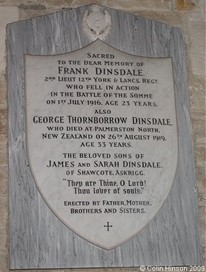
Frank had been a favourite with both his brother officers and the men of his battalion and several of them spoke in high terms of his gallantry. The vice chairman of Leeds University had also testified to the esteem in which he was held by his college friends. When on leave, he had said to his family that if he was called to yield his life, they must not lament but ‘rather feel proud that it was for his country and his king that he had died.’
Frank is buried in Grave C20, Queens Cemetery, Pusieux, a village 15 kilometres north of Albert.
At least 5 of Frank’s siblings had emigrated to New Zealand before the first world war, Isabel, Ellen and Owen left in 1911; and John and George also found work farming in New Zealand. George died there three years after Frank. Their heartbroken parents had a memorial plaque put up in St Mary’s Church in Hardraw. Robert, Thomas and James remained in the UK as well as sisters Elizabeth and Frances.
John Horn's father, Jeremiah, was born in Preston under Scar, near Leyburn and he married Margaret who was also from Leyburn and in 1900 the family moved to Burtersett, where Jeremiah had a job as a stonemason and hewer of rock at Burtersett quarry. Their three children John, Anthony and George had all been born in Leyburn.
John, who was working at the quarry like his father, enlisted at Askrigg in October 1915, joining 4th battalion Yorkshire Regiment. He married a local girl Jane Ann and by the time of his death in September 1916, a child, Margaret, had been born.
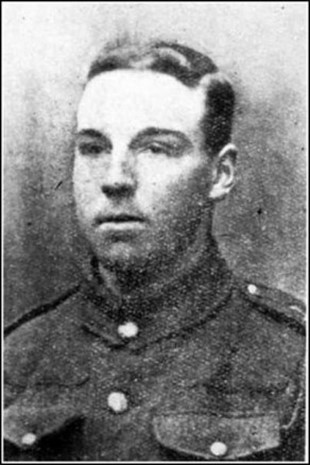 Embarking for France in April 1916 the battalion was not called upon to take part in the Battle of the Somme until 15th September, when the attack supported by tanks began. The battalion held the line for the next two days under heavy shellfire which caused many casualties. Soaked through and exhausted they were relieved on September 19th.
The plan for September 26th was to attack and capture the German trenches running from Flers. The battalion were to attack at 11:00pm in conjunction with the 5th Durham Light Infantry but, by mistake, the Durham's did not attack, and the 4th battalion found themselves in the German trenches with both flanks exposed and were driven out by strong counterattacks on September 27th. The losses were large and during the German counterattack, John was killed.
He was posted as missing, and it was not until early 1917 that Jane was notified that her husband had been killed. His name is the Thiepval memorial
Jane and her daughter Margaret lived with her parents-in-law after John’s death and on the 1921 census, the extended family is still living together in Burtersett. Jane remarried in 1931 to Thomas Christopher ‘Kit’ Calvert.
His brothers, Anthony and George, both married and took up farming, leaving Wensleydale. Anthony and Mary farmed near Harrogate and George and Alice at Gibraltar Farm in Lancashire.
Thomas Kirkbride, a cattle dealer born in Gayle, near Hawes married Margaret Terry from Askrigg in 1890. The couple and their expanding family lived in Worton for a number of years before moving to Town Head Farm in Askrigg. They had 13 children – Frederick, Thomas, Mary Elizabeth, Annie, James, Ernest, Esther, John (known as Jack) William, Margaret, Henry, Agnes and Laura.
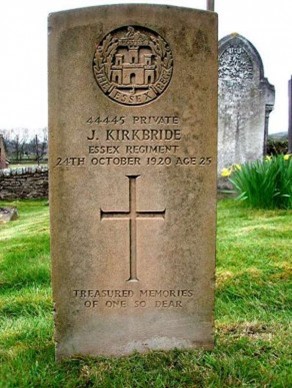
All four older boys fought in the WW1 and all survived the war but sadly Jim, as James was more commonly known, was severely affected by a gas attack on the Western Front, when serving with the Essex Regiment. He was returned to England, still suffering badly from the effects of the gas and was in a convalescent home, in the Durham house provided by prime minster, Anthony Eden’s mother.
Jim died on 24th October 1920 aged just 25 and was buried in the churchyard of St Oswald’s church.
Also buried in the churchyard are Jim’s sister Esther, who died in 1919 and brother Jack who died in 1927 aged 26, less than a year after his marriage to Agnes Robinson.
All his remaining brothers farmed in and around Wensleydale – Frederick in Countersett, Thomas, William, Ernest and Henry in Askrigg. The family still farm in Askrigg today.
The Kirkbride family were dealt another blow during the second world war, which claimed the life of Sidney Chapman Kirkbride, the eldest son of Jim’s brother Thomas.
Bernard Grime Lodge was the only child of solicitor John James Grime Lodge and his wife Sarah Ann Preston. John was born in Hardraw, the eldest son of Thomas Lodge, who was at the time of John’s birth, the Vicar of St Margaret’s in Hawes. Sarah was the youngest child of John Preston and Elizabeth (Graham), who farmed in and around Askrigg. The couple married in Blackburn on 23 April 1893 and Bernard was born the following year on 23 March 1894.
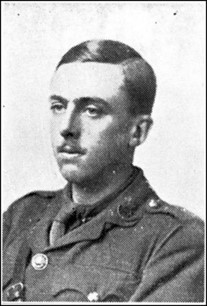
Bernard was just 3 when his mother died, and he and his father went to live with Anne and William Balderstone at Yorebridge. Anne was John’s older sister, and she was married to schoolmaster William Balderstone. He attended the Yorebridge Grammar School and then Giggleswick School before beginning a career in banking with Barclays Bank. He was also related to the Reverend Christopher Whaley (vicar at Askrigg), who was married to his aunt Agnes. In 1914 he enlisted in the 19th Universities and Public Schools Battalion, The Royal Fusiliers aged 20. He embarked for France with the British Expeditionary Force and returned to England later to join an Officers Cadet Force. He obtained a commission in August 1916.
He returned to France, attached to the 10th Battalion of the Durham Light Infantry and he was the Battalion Bombing and Intelligence Officer. Bernard died at Inverness Copse on 24 October 2017, during the battle of Ypres.
His commanding officer wrote to Bernard’s father:
‘It is with the deepest sympathy that I write to tell you of the death in action of your charming boy, who was my intelligence officer. A braver, cooler and more reliable officer could not be found. He had done wonderfully gallant work on patrol on numerous occasions and whatever the job he had to do, I could absolutely rely on his doing it thoroughly. I know no other officer in the Battalion I could have spared less than he. He was brave as a lion. We were counter-attacked at 4.30am on 24th and I turned out all the men at HQ. He, without any orders, dashed off with the leading men right up to the front where danger threatened. I don’t know how I shall replace him as not only was he valuable as an officer, but I was very fond of him, as were we all.’
He was mentioned by Sir Douglas Haig in dispatches for his gallant and distinguished service.
Second Lieutenant Bernard Grime Lodge is commemorated both here, and at the Tynecot Memorial in Flanders (panel 28).
Bernard’s cousins John and James Preston, sons of Sarah’s brother James, were also both involved in WW1. Whilst John survived and returned to his wife Lizzie (who was also a cousin of Bernard and John through Sarah and James’ sister Margaret!) his younger brother, James, died just over a week after Bernard following wounds sustained in battle aged just 20.
Of all of the names of the WW1 memorial, John is the one we know least about. This is partly because the Metcalfe name is relatively common in Wensleydale, and that on all the memorials and paperwork, there is only one name given – John is listed as the son of M A Metcalfe.
Investigation gives the following as the likely family of John James - if anyone can confirm or add to this, we would love to hear from you. His great grandparents were James Metcalfe and Mary Cockfield, who farmed in Woodhall. James died in 1845 after just five years of marriage, leaving Mary to manage the farm and two young children, Jane and James. Jane was born in 1842, and in 1863 she gave birth to a daughter Mary Alice, who would become the M A Metcalfe mentioned on John’s paperwork. Mary was brought up at the farm with her grandmother, mother and uncle but when her mother married stonemason Jeffrey Miller in 1879, Mary remained on the farm with her grandmother, while Jane and her husband lived in Hawes with their growing family.
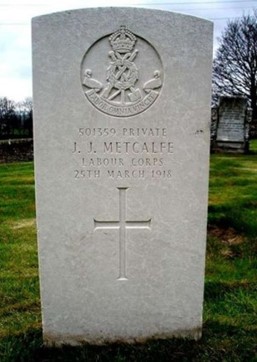
Mary became the mother of three illegitimate children – Mary Jane, Elizabeth and John James. She lived initially in Worton, working as a charlady to bring in some money. The family later moved to Main Street, Askrigg where Mary worked as a laundress. John was born early in 1896 and enlisted in the army on 19th February 1915 at Leyburn recruiting office aged 19. He was sent out to Egypt just 5 days later as part of the Expeditionary Force but was admitted to hospital in Alexandria suffering from dysentery in September 1915. He was sent back to England to continue his recovery. Whilst fit enough to remain in the army, he remained in the UK and was transferred to the Royal Army Service Corps.
In December 1917 he was admitted to the army hospital suffering from chest problems and weight loss. Tests showed he was suffering from tuberculosis affecting the lungs and he remained in hospital until 28th February 1918. He was discharged from the army on 21st March 1918 and his discharge papers state that his condition was 100% attributable to his army service in Egypt and Gallipoli. It was recommended that John be placed in a sanitorium after his discharge, however he died just 4 days later and was buried in the churchyard in Askrigg.
If the records are interpreted correctly, John’s elder sister, Mary Jane, married Robert Mudd, another name on the WWI war memorial.
Robert was born in Thornton Rust in the summer of 1893, the youngest child of George Metcalfe and Grace Pickering. George was a farmer, born in nearby Bishopdale who married Grace in 1884. The couple had seven children, 4 boys and 3 girls. Robert worked on the farm, but during the war enlisted in Leyburn was posted to 8th Battalion, KRRC.
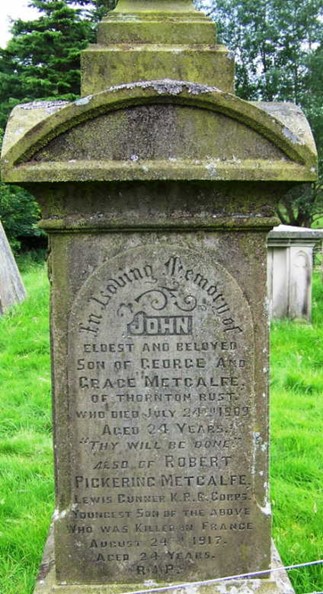
On 22 August 1917, Robert’s battalion were in Sanctuary Wood near Ypres, close to the position occupied by Bernard Grime Lodge, another soldier on the War Memorial. They were being heavily shelled and had lost 50 casualties. As they were about to be relieved on 24th August, an SOS signal went up, indicating a German counterattack near Inverness Copse, where the battalion was pinned down.
The counterattack was a failure, except on the left, where a few patrols pushed through, but they did not get very far. During the day, the 8th Battalion had to withdraw from the Copse and suffered severe casualties from shell fire, losing six officers and 100 casualties from other ranks. Robert was one of those killed, the first soldier from Thornton Rust to die in action. Rifleman Robert, along with a party of 10 others, were ordered to storm the front line of the enemy’s trenches, when a shell burst amongst them, causing the death of all but two who were severely injured.
His Captain wrote in a letter to Robert’s mother, ‘Your son has done extremely good work out here as a Lewis gunner and his death is greatly deplored by all of us’. Robert’s name is commemorated on the Tyne Cot Memorial.
George and Grace had lost their eldest son John in 1909 and had now lost a second. Before their own deaths in their 80s, another son, Thomas would die in 1938 and a memorial to their three sons and to Grace and George is in the churchyard of St Andrew’s Church in Aysgarth. Their remaining son, George (1888-1970) married Martha Slinger Dinsdale in 1915. As for their daughters – Mary Alice (1887-1975) married Askrigg farmer Ralph Tiplady Metcalfe in 1914, whom she got to know when her brother Robert worked for him in 1911; Elizabeth (1889-1975) married dairy farmer Thomas Tennant of Worton Hall, and Anne Margaret (1890-1972) remained at home looking after her widowed father and after his death married Joseph Lambert North in 1946.
Thomas was born in Woodhall in 1899, the middle son of George Coates Miller and his wife, Margaret (nee Holmes). George farmed in Woodhall and had married Margaret, from Carlton in Coverdale in 1894. They had three sons – John (known as Jack), Thomas and James and three daughters, Margaret, Alice Henrietta and Mary Elizabeth.
Jack and Thomas worked with their father on the farm, with Jack enlisting in January 1916 and being posted overseas with the West Yorkshire Regiment in June 1916. Jack was posted missing on 5th September 1916 but was found and taken to the field hospital with a gunshot wound to the chest. He was transferred by to England but recovered sufficiently to return to the front in January 1917.
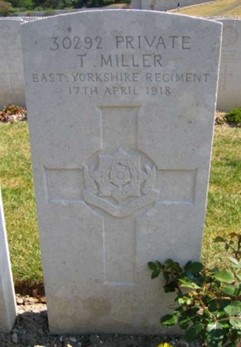
In February 1917, Thomas enlisted in Richmond and also to the West Yorkshire Regiment. With them, he embarked for France in October 1917 and fought in the Battle of Cambrai. On Christmas Day, he was taken to the General Canadian Hospital in France suffering from severe boils and was eventually transferred back to Carlisle on 12th January 1918. From there he was able to spend some of his convalescence time with his family. Skin problems were common in the trenches because of the terrible cramped and wet conditions. His brother Jack was admitted to hospital later in the war with scabies.
Thomas returned to France and was drafted into the 10th Battalion, East Yorkshire Regiment and from 26th to 31st March was heavily involved in stopping the Ludendorff Offensive in an area to the northwest of Bapaume. When the second thrust of the Offensive began on 9th April, Thomas’ battalion was in the vicinity of Armentieres, on the northern side of the river Lys and was engaged in fierce fighting.
On 13th April, Thomas was badly wounded having sustained serious injuries to his spine and he was paralysed. He was sent to a hospital in Etaples, where he died from these wounds on 17th April. He is buried in grave XXIX E.9 in Etaples Military Cemetery. The matron of the hospital wrote to his mother, Margaret, telling her that he suffered no pain, as much of the time in the hospital he was unconscious. He had wanted for nothing and was well tended by the British nurses.
A memorial service was held in St Oswald’s the Sunday after his death. In his tribute, Revd Squibb said that he had met Thomas just a few weeks earlier when he had been on leave and he had been walking down the road ‘full of vim and vigour, with the usual cheery smile on his face’. He added that Thomas had been ‘a bright, loveable lad’ and that his heart went out to his parents.
His brother Jack (1896-1980) returned from the war and eventually took over the running of the family farm from his father, with the help of younger brother James (1900-1975), who had been too young to enlist and who never married. Margaret (1894-) and Mary Elizabeth (1904-1995) never married either and also remained on the family farm. Alice Henrietta (1902-1985) married neighbour James ‘Jimmy’ Alderson, a garage owner in 1925.
John Mitton, born in 1877, was the eldest son of Warrin and Ellen Mitton (nee Atkinson). Warrin was a joiner and farmer, born in Askrigg, but settled in Hawes with his Sedbergh born wife. The couple had three children, John, Nancy and Thomas. John initially worked with his father on the farm, but then became a postman. He married Mary Teresa Frost in 1905 and worked for a while in her home village of Finghall and the surrounding area. When he left to move to the Askrigg, the residents of Finghall clubbed together to buy him a marble clock and a pipe together with a purse containing cash as a leaving present, which must show the regard in which he was held.
The family – John and Mary and their two daughters Ellen (1906) and Mary (1908) – moved to Askrigg, where John continued to work as a postman. He played for many years for the Hawes football team and acted as their secretary for 2 years. He was also a fine billiards player. As a youth, he was a member of the St Margaret’s Church choir in Hawes, and later sang in the choir here in St Oswald’s. He was an outgoing man and had many friends.
John enlisted in Leyburn and joined the 2nd Battalion, Yorkshire Regiment, embarking for France at the end of July 1916. On 7th April 1917 the Battalion moved from Bellacourt to Blairville, south of Arras, ready for the start of the Arras Offensive scheduled for the 9th. They followed the first wave to mop up the open ground until held up by the German wire. One party established itself in shell holes, joining them up by digging trenches during the day and here they remained under shell and rifle fire until relieved at 1am on 10th April.
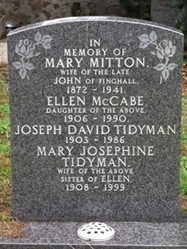
John was one of 24 killed – a further 89 were wounded and another two missing presumed dead. He was buried in Grave D15 of the Neuville-Vitasse Road Cemetery, 6 miles SE of Arras. John’s brother Tom had joined up around the same time as his brother and was in France at the same time with the Royal Field Artillery. Fortunately, he survived the war and returned to his wife and home in Liverpool. Their sister, Nancy Metcalfe Mitton remained unmarried and died in Hawes in 1946 aged 65, leaving her estate to John’s eldest daughter, Ellen.
John’s wife Mary did not re-marry and, after her daughters left home, lived for a while with her unmarried sister, Lucy, in Lancashire, where she died in 1941.
Daughters Ellen and Mary both married in Leyburn in 1931, with Mary marrying a dairy farmer, Joseph Tidyman, and Ellen, a draper, Joseph McCabe. All three are buried in the Roman Catholic churchyard at Ulshaw Bridge near Middleham.
Born in Ripon in 1881, Robert was the son of Edward Mudd and Margaret (nee Casey) of Masham and the husband of Mary Jane Metcalfe. He came from a large family, having had 12 siblings. He joined the army aged 18 in 1899 and went through the Boer War in which he was wounded. He held the South African medal 1901 to 1902 with five bars -Laing’s Neck, Transvaal, Relief of Ladysmith, Orange Free State and Tugela Heights. His elder brother Edward was also in the army and fought in South Africa. He was, however, invalided out in early 1902 and died in 1907.
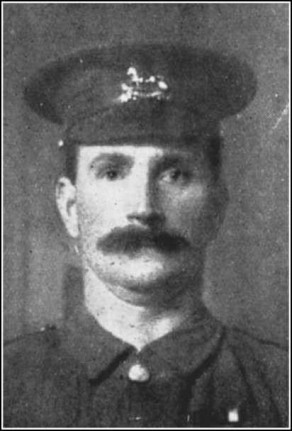
Following his time in the army, Robert became a stone mason. Early in January 1912, he married Mary Jane Metcalfe here in St Oswald’s Church. Mary had lived in Main Street with her mother and brother for all her life, and had a child, James, who was born in 1910. The couple continued to live in Askrigg and had two boys of their own, Edward born on 13 August 1912 and Leonard, 11 April 1915, both baptised in the church.
When war was declared he was in the second reserve and his time would have expired in November 1914. He was one of the first to be called to the colours and left his wife and three children in Askrigg to enlist in York, where he joined the 10th battalion West Yorkshire regiment. He acted for some months as a drill instructor but was sent to France on 12th July 1915 and remained there until December of that year, when he claimed and obtained his discharge. He resumed civilian life, being employed by G Dougill and Son contractors of Aysgarth.
Robert was called up again on 28th June 1916, just six months later and was sent to back France six weeks after that, where he was joined in the battalion by two of his brothers. In total three of his brothers fought in WWI. On 13th April 1917 during the battle of Arras, the battalion was in the vicinity of Monchy-le-Preux, just to the east of Arras. All day long the enemy, assisted by air support, heavily shelled the frontline trenches and casualties were severe.
Robert and two officers in who were in close proximity were all killed when a shell dropped onto their position. He has no known grave, but Robert’s name is found on Bay four of the Arras Memorial.
Of Robert’s siblings, married carter, James (1875-1903), invalided soldier Edward (1877-1907), stone mason John (1878-1908), Margaret Ellen (1885-1904) and Frederick (1891-1907) had all died before world war one.
All three of his brothers also fighting – Francis, George and Joseph – returned safely. Francis (1883-1959) was a platelayer and had signed up in June 1916 and was in the Royal Garrison Artillery. George Henry (1889-1949) was a quarryman and signed up in September 1915 and was with Robert in the Yorkshire Regiment. Joseph (1895-1977) was the first of the brothers to join up in August 1914. He was wounded a couple of times during the course of the war, but fortunately received only minor injuries and he was promoted to corporal towards the end of the war. On demobilisation he became a farm foreman.
Of his other siblings – Sarah Ann was born in 1893; Christopher (1897-1927) joined the army for a short spell before being medically discharged and married Mary Jane’s sister, Elizabeth here in Askrigg in 1918. After the war he was a forester. Youngest brother Leonard (1901-1985) became a shepherd.
Robert’s widow, Mary Jane, married Richard Heslop in 1919. His son Edward married Gladys and worked in the Steel Industry. His youngest son, Leonard, worked as a quarryman and in 1939 was living with his widowed aunt Elizabeth.
James was the son of Askrigg farmer James Preston and Margaret Ann (nee Chapman) who lived at West End House in Askrigg. James and Margaret had five children, 4 sons and 1 daughter.
Their eldest son Charles (1882-1914) went to Liverpool before the Great War to run one of the milk houses but died just as the war began. He was married and had four children. Another son, John, (1883-1948) known as Jack, also went to Liverpool and married Lizzie Preston Banks, who died shortly after giving birth to their only child, Constance Margaret, born in 1910. Jack brought his daughter home to Askrigg where he worked on the farm. He enlisted in the army in 1915 and didn't return to Askrigg until April 1919. He fought at Gallipoli and in Egypt, returning home to West End House, where he died in the 1940s. He was the founder of 'The Gallipoli Association'.
James and Margaret’s only daughter Isabel (1893-1974) married John Tiplady Leyland, a grocer, in 1919 and they lived in Bainbridge. Youngest child, Frank, followed his brothers and father into farming; although he moved with his wife Jean Mearns to Easingwold where he kept a dairy herd.
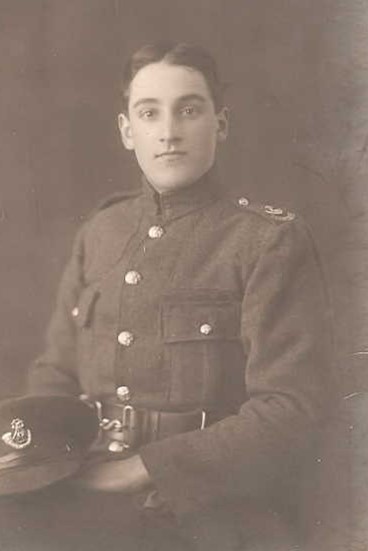
Middle son, James Preston, or Jim as he was commonly known, was in training at Becketts Park College, Leeds to become a teacher with his cousin Dick Chapman also from Askrigg. Jim had won two medals and a certificate for swimming and beat the five-mile junior college record for running, doing the distance in 32 minutes and 30 seconds. He was a member of Askrigg church choir and a Sunday school teacher for several years. He had been a pupil teacher at Askrigg day school. Jim volunteered for the army whilst at Leeds in 1915 and joined up in 1916, going to France in January 1917. He first joined the Royal Field Artillery but later transferred to the 18th Battalion Lancashire Fusiliers, where he became a bugler.
He twice refused a Commission, preferring to serve as a private. On his 20th birthday, the 22nd of October 1917, the battalion took part in the attack on Houthulst Forest in the Ypres Salient, pushing forward but receiving heavy casualties. Some concrete bunkers occupied by the Germans had not been dealt with and machine gunfire from them caused numerous casualties all day.
The battalion was in a very exhausted state owing to the heavy and broken ground. Many of the men had lain all day in shell holes up to their waist in water. A number of wounded were brought in who had been left out during daylight owing to the continual sniping by the Germans. One of these wounded fusiliers was Jim, whose lung had been pierced by a bullet and he was transferred to the vast hospital complex at Wimereux on the coast north of Boulogne.
Jim had returned to France six weeks before his death, after spending 10 days leave at home. He wrote to his cousin Dick at Wharton House in Askrigg just two days before he died. He wrote:
Dear Dick, I don’t know whether you are at home but still am dropping you these few lines to let you know that I am still going on alright. I suppose you will have got the news that I am wounded in the back – a birthday present it was. I am now in No 4 Gen Hospital No 1 Ward, No 3 bed and am having a pretty good time – if it wasn’t for having to lie in bed all day and in pain every time I move, everything would be A1. We are on the sea front, and I can sit in bed and look out the window watching the waves and the boats going across to Blighty. I hope to be on one of the latter soon and shall try to get to Beckett’s Park Hospital if it can be done. Well the best of luck. Yours sincerely Jim. PS excuse weak letter, am not in form for letter writing
The matron from the hospital wrote to Jim’s parents: ‘your boy died at 11:30am this morning. All day yesterday, he was becoming gradually worse and when I saw him this morning, I felt he could not last long. He was perfectly conscious then and when I asked him how he felt he said I am rather weak. I told him I would write to you today and he said, send my love and remember me to all my relatives. I am so very sorry; he was such a sweet boy.’
Jim had written home every day after he was wounded, right up to the 31st of October and he died on 2nd November. He is buried in grave V1 F 21 at Wimereux communal cemetery. During 1917, Jim and 24 other Wensleydale men were killed or died as a result of actions in the Ypres Salient.
Jim’s cousin, Dick Chapman, to whom he wrote the letter, was the son of his mother’s brother Azariah. He completed his teacher training and worked in Bingley. He returned to Hawes in later life.
William’s parents were John Anthony Webster, born in Barningham, a little south of Barnard Castle and his wife, Jane Stockdale. The couple married here at St Oswald’s in 1874 and lived at Nappa Scar, with John farming the land around their home. They had a large family Matthew (1875-), Elizabeth (1877-), Sarah Ellen (1879-), John William (1881-1956), Mary Jane (1883-1961), Christopher Tomlinson (1855-1959), Thomas Edward (1886-1935), Samuel Stockdale (1888-1922), Dora Stockdale (1890-), Hannah Jane (1892-196) and William was the youngest, born in 1895.
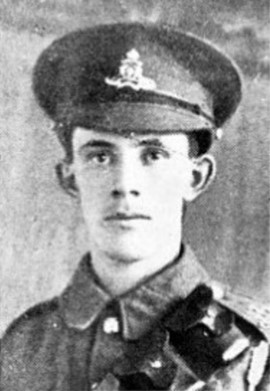
As a youngster, William worked on his father’s farm and was a member of the church choir in Askrigg. He was working for a dairy in Liverpool when he enlisted in the army in May 1915, aged 19. His brothers Thomas and Samuel also enlisted in the army.
Although Thomas and Samuel survived, in August 1917, William’s parents received the news that William had died in hospital in France.
He was a gunner in a trench mortar battery and had been in France since December 1916. He had been slightly wounded on 7th July, but on the night of 29th July, his billet was heavily shelled with gas canisters. He assisted his comrades who had suffered more than himself and afterwards was taken to one of the military hospitals in the base at Etaples, 27km south of Boulogne. William’s condition deteriorated and he developed pneumonia from which he died on 5th August. He is buried in Grave XX11.0.21A in Etaples Military Cemetery
Of William’s sisters - Elizabeth married John Thompson and Sarah married Matthew Wells both of whom were farmers. Mary Jane was widowed shortly after her marriage to John Guy and was left with two young sons. Dora married gardener William Metcalfe and Hannah married cowman John Allison. William’s brothers all were connected with farming, Christopher married Georgina, Thomas married Annie and Samuel, Mary Gibson.
WWII
The Brown family have farmed in the Upper Dales for at least two centuries. Walter’s great grandfather, Robert, was born in Mallerstang, between Kirkby Stephen and Garsdale. After his marriage to Mary Kilburn, the family moved to Gill Edge, just south of Bainbridge towards Countersett and the family remained there throughout the generations. Walter was born there on 20th August 1917 to Edward and Annie (nee Brockell). He was baptised along with his elder brother Henry on 22nd March 1918 at St Askrigg Church. In addition to Harry, Walter also had two other elder brothers, Percy and John, an elder sister, Jenny.
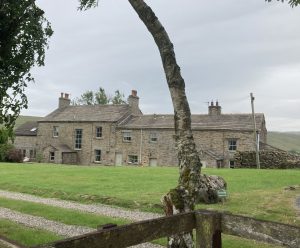
Walter worked on the family farm first with his father and brothers, and after his father’s death, with his brother John. After the war broke out, Walter went down the mines near Durham as one of the ‘Bevin Boys’. Named after the former union official Ernest Bevin, who was the Minister of Labour and National Service in the wartime coalition government, 10% of conscripts aged between 18-25 were chosen to be Bevin boys. In addition, some volunteered as an alternative to military conscription. Recruits were needed in the mines as the government needed to increase the rate of coal production which had declined in the early years of the war. Despite it being a dangerous and vital occupation, Bevin Boys were often targets of abuse from the general public who mistakenly believe them to be cowards or draft dodgers.
Walter did not take to working in a mine and enlisted as a trooper in the Royal Armoured Corps, as the driver of an armoured car. The 11th Hussars went into France after the D-day landings and took part in the Allied advance into Belgium and Holland. On 1st October 1944, Walter wrote home telling them that they had gone through Belgium the month before and had received a good reception from the population. He had had to drive with one hand on the steering wheel and the other taking in gifts from well-wishers. They were showered with beer and fruit and cheered by the children. He went on to say that they were now ‘somewhere in Holland’ and that he had had the opportunity to milk some cows and that the windmills were ‘a grand sight’. A letter in mid-December, tells of increasing shelling, and that this was becoming nerve-racking.
Walter was in 3 Troop, B Squadron and drove Sergeant McGuire, its commander. McGuire was a decorated soldier, having won the Military Medal earlier in the campaign and on 28th November he had been presented with his ribbon by Field Marshal Mongomery. The 11th Hussars were near Bree in Holland but at the start of December they moved to the Maaseik and Ophoven area, on the river Maas. They were due to cross the river to go into the line at Roosteren and Illikhoven. B Squadron were responsible for about 3000 yards of the front, with no defences except the Juliana canal, whose bridges had been blown. The plan was for each patrol to form a strong point at night and try to observe by day, without being seen. In support were around a 40 strong contingent of the Dutch Resistance, who were equipped with all sorts of German weapons which they had captured. Every so often, B squadron would get 4 days leave, often spent in the hot baths of a nearby colliery – a chance for a general clean up; and the opportunity to see a cinema show or two.
On Boxing Day 1944 at 5am, gunfire and machine gun fire began when the Germans attacked D Squadron in Gebroek village. They overran the village, but the troops managed to get out with only minor casualties. No 3 Troop were sent to Illikhoven to watch the canal in case the Germans attempted to cross it. A few shells burst around their position and one landed on the house they were hiding behind, killing Walter. He was extremely unlucky as the Troop had not been seen by the Germans and the shells were probably ones that that misfired.
Walter was buried in grave 23.H.5 of the Jonkerbos War Cemetery, Nijmegan. For Walter’s family, the celebration of Boxing Day was forever marred by his death.
Walter’s brother John (1910-1985) continued to run the Farm at Gill Edge, along with his wife Ruth Mason, whom he married in 1938. His brother Percy (1912-1973) married Annie Raw in the same year and Percy worked as a dairy farmer, living in Bainbridge in the 1940s. No details are known about Walter’s siblings Henry Gilbert (1915-1985), known as Harry and eldest sister Margaret, known as Jenny (1908-).
George’s family had lived in Bainbridge for at least four generations. His father John owned a lot of property in the area, including the Corn Mill. During the 1920s the corn mill became a cheese dairy and the family lived nearby. John also kept animals on land near Semerwater and had a butcher’s shop in Bainbridge, with a slaughterhouse behind.
John married Alice Daykin from Nappa Scarr and the couple had 11 children - 2 girls and 7 boys survived to adulthood with George being the second youngest. Eldest Richard became a butcher and took on the shop, Guy a cattle dealer, Harry a stockman and Kenneth a policeman. George became a mechanic and his sister Doris married butcher Reginald Allen and youngest sister Margaret married motor mechanic Harry Metcalfe. It is unclear what happened to his brothers John and Sidney.
Initially George went to Bainbridge School, followed by Yorebridge Grammar School before an apprenticeship at Kettlewell’s Central Garage in Hawes. Growing up he had developed an interest in motor sport, and motorbikes in particular. He even became a semi-professional speedway rider during the late 1930s. The Cockbone Cup was presented as a prize at Bainbridge Sports for Motorbike racing in recognition of George’s dominance of this event in the 1930s, when he was the only rider to reach the top of the motorbike hill climb, which he often did standing on the seat of his bike! His dare devil attitude made it inevitable that he would join up soon after war broke out and he joined the RAF as a fighter squadron pilot.
At the beginning of 1940, he married Beatrice Jean Fawcett, known as Beatty, who lived in Dent, at the church in Cowgill. The couple lived at Spice Gill, Dent and were joined by their son, Desmond, in the summer of 1940.
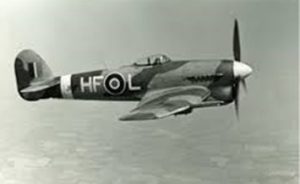
George joined 175 Squadron and in mid-1942 was based in southern England initially flying Hurricanes. Later in the war, the squadron were supplied with Hawker Typhoon fighter planes, which were rocket firing and were often used as ‘tank busters’. On 2nd June 1943, the squadron moved to a new base near Chichester in West Sussex.
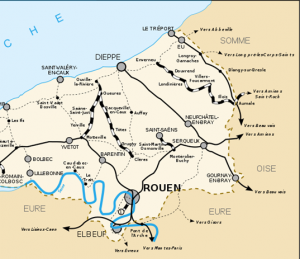
Just over two weeks’ later, George took off from the airfield in Typhoon EK184 on a fighter sortie mission against opportune targets on the ground. The RAF slang for this was a ‘rhubarb mission’. He crossed the English Channel and then the French coast a little west of Dieppe. He flew at low level inland looking for targets on the railway line or military vehicles on the roads, and whilst doing so was shot down with no chance of using his parachute to escape.
His plane crashed near Motteville, around 20 miles south of Dieppe. He is buried in grave H.57 in the Dieppe Canadian War Cemetery.
Lewis Hindle was born in Halifax but moved to Bainbridge with his wife and young family in 1927. Lewis worked as a carter initially, and married Harriet Holdsworth in 1904. Their daughter Ellen was born the following year. The young family moved to Blackpool, where Lewis worked for Cash’s bakery, initially as a delivery driver and then learning the business. Their son, Jack, was born whilst they were in Blackpool and was 8 when they moved to Bainbridge, where Lewis opened a bakery at the top of the Green. Just 7 years later, Lewis died of TB, leaving Harriet and Ellen to run the business. As well as the bakery, which also had a café within it, they opened a grocery shop in Askrigg. In the 1939 census, Jack was listed as the baker and delivered the bread across a wide area.
Jack had gone to the village school and then on to Yorebridge Grammar School. He joined the Royal Army Medical Corps at the start of the war and was sent to France with the British Expeditionary Forces, tending the wounded in an army field ambulance station before being evacuated at Dunkirk.
Jack had been courting Irene Fawcett, the daughter of John & Martha Fawcett of Nappa Hall, near Askrigg and on 11th October 1942, whilst on leave, Jack married Rene at St Oswald’s Church. Initially, Jack was stationed on Salisbury Plain, and Rene followed him and worked at an aircraft factory.
Jack’s captain was keen for greater military action and volunteered his unit for training to go into action with the newly formed Parachute Regiment. In the middle of 1943, the 6th/10th Parachute Regiment were in the Mediterranean and Jack was with them and was there in November that year when his daughter Anne was born.
Jack had not been involved in fighting in North Africa, but had been training hard with the Parachute Regiment, undertaking three practice jumps. The unit were expecting to take part in the invasion of Sicily, but whilst waiting on the plane to take off, their mission was cancelled. Instead, the unit headed for Italy, sailing across the Med to Taranto. Arriving at the harbour, Jack’s ship was the first to arrive and most of his colleagues were on deck getting their kit together. A sudden and violent explosion ripped through the ship, which split in half as the ship hit a mine. Jack and around 20 other men were below decks at the time of the explosion. It was dark and the water began pouring in, when Jack took charge and got the men moving out in an orderly fashion. He remained below decks until he was sure everyone had escaped. He was recommended for a medal, but nothing ever came of it.
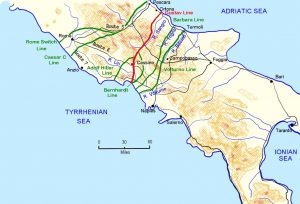
On 1st December 1943, they were in central Italy and were sent into the line for the next six months. Jack worked hard picking up the wounded under shell fire and displaying coolness under fire and good judgement. He is described by his commanding officer, Captain Stock as being considered by the men as ‘our doctor’.
The unit were involved in the Battle for Cassino but were brought back to Salerno to prepare for a parachute drop behind enemy lines north of Cassino. The plan was to get into position behind the main German supply route in that area and then destroy the German transport. Two medical Corporals and two orderlies were to be sent in with the main force and because Jack was one of the best, he was chosen for the mission. The parachute drop was successful, and the team climbed over the mountain ridge into the next valley where the supply road lay. They had moved over night and the following morning they split into four parties to complete their mission. Jack remained high up in the mountains with the headquarters of the unit, whilst the fighting patrols moved and worked at night and hid during the day to avoid detection.
The cover was less than expected and the Germans reacted strongly, sending a brigade in to try to find the British Parachutists who were disrupting their supply lines. On 4th June, a German patrol came across Jack and a few other men and, after a brief fight, overcame them. Jack was shot through the head and died instantly. Some of the British escaped and came back the following day. Jack’s body was found and was buried in those hills on the side of the main road some 40 miles north of Cassino, which is where he remains.
He is commemorated on Panel 12 of the Cassino Memorial, Italy.
Jack never got to see his daughter, Anne who lived at Green View in Bainbridge with Rene until her marriage in 1966. Jack’s elder sister Ellen married Norman Willis just after the war and the couple remained in Bainbr
Sydney was born on 16th August 1915 in Askrigg, the eldest son of Thomas and Isobel (nee Chapman) Kirkbride. His father was a dairy farmer and cattle dealer, just like his grandfather before him. Thomas often travelled through Swaledale buying cows and sheep and on occasions he was accompanied by Syd and his brother Thomas junior (1917-2007). Syd’s grandmother, Mrs Chapman, was also responsible for his upbringing and said that he was a kind and sensible, caring lad and she thought the world of him. Syd and Thomas had a passion for trainspotting, often visiting the station at Garsdale or sometimes even as far as Danby Wiske on the East Coast Line. Syd also two sisters, Margaret, born in 1913 and Esther Shelagh (1924-2010). Syd attended Yorebridge Grammar School and went straight from there to RAF Cranwell as a 17-year-old cadet in September 1932. Three years’ later he was a wireless operator mechanic, but by December 1938 he was training to be a pilot, which he achieved by August 1939, just as war was about to be declared.
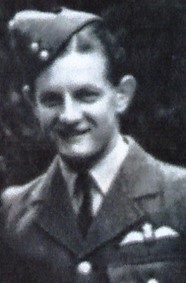
During his time in the RAF, he had been posted to Iraq in October 1936 as a wireless operator, based at Air Depot Habbanyia which was on the river Euphrates west of Baghdad and saw service in Palestine. As a sergeant Pilot, he was posted to 37 Squadron at Feltwell in Norfolk on 20 December 1939, flying Wellington bombers. Between qualifying as a pilot and his posting, he married Kathleen Mary Middlebrook in Bradford on 30th September.
Two days before Syd joined the Squadron, six Wellingtons from 37 Squadron had joined in a disastrous raid to locate German warships along the coast of Heligoland. They were attacked by enemy fighters and five of the six Wellingtons were shot down.
The Wellington was barred from taking part in any such future raids and instead the Squadron concentrated on attacking targets in Northern Europe – most of them being night bombing missions, as well as targeting sites in Norway, during the period of the German invasion of that country. Sydney’s worst flying experience so far came on one such raid, when a heavy snowstorm forced them to fly dangerously low to try to avoid the worst of it.
Much of what we know about the raids that Syd took part in is from his letters home to Kathleen. On 14th May he wrote about participating in night raids, including one on Rotterdam. On 22nd May he wrote ‘very busy lately and four flights out of six have been on bombing raids destroying railways and bridges. We were out on Wednesday, Friday, Sunday and last night. So, we are doing our share all right. We lost one plane last night, but none on the other trips. Last night we were in Aachen in Germany bombing railway sidings. Did you hear it on the 1 o’clock news today?’
In his next to last letter some of the fatigue of constant missions is evident. He wrote ‘I feel much better than I did yesterday. I was awfully tired when I wrote to you. I can’t for the life of me sleep through the day, but I shall see the doctor soon and he’ll probably be able to help me. Apparently, I’m not the only one who suffers this way’.
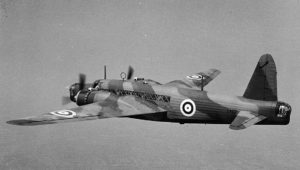
Within days of this letter, Sydney was dead. He flew regularly with Sergeants Charles Read (aged 20), John Francis McCauley (aged 25) and T Johnson and Warrant Officer George John William Grimson (aged 32) in Vickers Wellington L7792. At 10pm on 14th July 1940, their Wellington, piloted by McCauley, with Syd acting as navigator, took off from Feltwell for a raid over Hamburg and Bremen, together with 8 other Wellingtons from their unit. The objective was to bomb widespread targets in and around the ports, including the marshalling yards in Hamm and the oil storage depots in Bremen. The weather and visibility were good, and all aircraft identified the primary targets. One plane failed to return and that was Wellington L7792. The captain of a New Zealand plane reported seeing a Wellington shot down close to Bremen.
This was indeed L7792 which was shot down by the No 1 Flak Reserve at 182 Blumental-Bremen. Three of the crew, including Syd, were killed whilst Sergeant Johnson and George Grimson were taken prisoner by the Germans. Sidney, McCauley and Read were buried with full military honours by the German army in Bremen, but after the war they were moved to Becklingen War Cemetery near Soltau, between Hamburg and Hannover. Johnson and Grimson were imprisoned in Stalag Heydekrug, but Grimson escaped and was on the run for a while. He was never seen alive again and it is thought he was caught and shot by the SS sometime in 1944.
The news about Syd was received at home by his wife, Kathleen and 12 days later gave birth to a baby daughter. Desperate for news of what happened, Sydney’s mother wrote to the father of one of the crew members who had survived and was taken prisoner. Eventually on 16th March 1941 Sergeant Johnson, Prisoner of War, wrote this letter to Isobel Kirkbride.
‘Thank you very much for your kind letter. My father has told me that you were writing to me, and I was very glad to hear that he had written to you and was able to put your mind at rest by letting you know what happened to Syd. I can hardly believe that Syd has gone, for I have flown on his crew all the time. I always experienced the upmost confidence in his ability as a pilot. I shall always remember Syd by his cheerful smile and optimistic attitude during moments of great danger, it made me feel proud to be flying with him.
We were victims of a direct hit, which struck the cockpit, the pilots received the full force of the blow, killing them instantly. The only survivors were the rear gunner and myself, who escaped by parachute. Syd was buried with full military honours in Bremen. I was unfortunate to be in hospital at the time. I gained details of the funeral from a guard who described it was ‘a procession worthy of a gallant flyer’.
No words can express the deep sympathy I feel for you. But as you say, we have many happy memories of Syd, these are immortal’.
Syd’s widow Kathleen and her daughter lived in Bradford. Kathleen remarried around 1960 after her daughter’s marriage in 1959.
Arthur and Caroline Percival arrived in Askrigg around 1935 and lived in Main Street with their daughter Anne. Arthur had been born in Swaledale but had moved with his family to Burnley in the late 1880s. He had joined the police force, risen through the ranks and retired as a superintendent after 30 years’ service just before the move to Askrigg. In 1910, he had married Caroline Waddington and the couple had two children, Anne and Frank. Anne was born in 1911 and became a hairdresser, setting up a business in Askrigg whilst she was here. Frank was born in 1915 and was a bright and able student and after school went to London University, where he attained a BSc (Hons) and worked as an engineer for an electricity company in Sheffield. At the weekends he would drive to Askrigg to spend the weekend with the family.
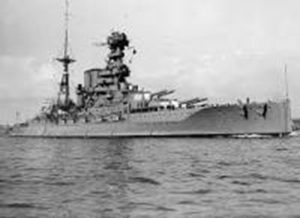
Frank joined up near the beginning of the war as a sub-lieutenant in the Navy and rose to rank of Lieutenant on the HMS Barham, which was a WW1 battleship, and he oversaw the engine room. The ship was part of the cruiser/carrier force in the Eastern Mediterranean led by Admiral Cunningham in 1941.
Activity in the Med was intense. Fighting in North Africa and Italy and the anticipation of attacks in the Balkans and Greece meant that the sea was full of troop carriers and supply ships. Where these were, submarines and aircraft followed and both sides were suffering shipping losses. Twelve extra U-boats were sent to the Med in November 1941 and soon had a devastating effect on the Royal Navy. On 12th November, HMS Arc Royal, an aircraft carrier with a full complement of aircraft and men, was sunk by torpedoes.
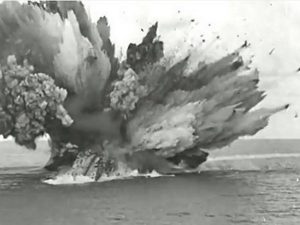
At 4.25pm on 25th November, HMS Barham was hit by three torpedoes from U-331, which struck from close range and impacted on the ship’s port side. Immediately the ship listed heavily to port and 4 minutes later, her magazine blew up. She sank quickly with the loss of 862 men, about two thirds of the crew. Survivors were picked up by HMS Hotspur and included Vice-Admiral Henry Pridham-Wippell.
The sinking of the ship was captured on camera for Pathe news by a reporter on board another ship, but it was not shown for some time as the news of the sinking was kept from the public as the dramatic footage was thought to be a threat to national morale. The commander of the U-boat, Oberleutnant zur See Hans-Diedrich von Tiesenhausen was awarded the Knight’s Cross of the Iron Cross by the German High Command for his actions that day.
No bodies were recovered from the Barham, which remains where it sank, around 200 miles off the Egyptian coast, west northwest of Alexandria. Frank’s body was never found but he is remembered on the WW2 memorial here in Askrigg, and also on the Portsmouth Naval Memorial (Panel 45, column 2).
Frank’s family moved away to Blackpool and his parents died in the 1960s. Anne died in 1983.
David’s grandfather, Alfred, was born in the City of London, and became a schoolteacher. In early 1870 he was lodging in Over Darwen in Lancashire and working in a local school and fell in love with a fellow schoolteacher, Sarah Spencer, from Burnley and the couple went on to have four children, Harry, Ivy, Sydney and Rennie. Ivy died as a child, but the boys all followed their parents into the teaching profession with Harry and Rennie working in secondary schools and Sydney becoming a physics lecturer at the University of Leeds.
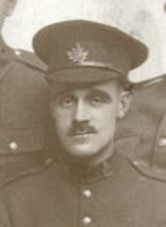
Growing up in Manningham and then Shipley, both suburbs of Bradford, Rennie studied Classics and then science at Cambridge University, afterwards teaching in Taunton and then Northallerton. On 23 April 1910 he married Mabel Banks, a farmer’s daughter from Kilburn. In 1922 the couple moved so Rennie could take up the position of Headmaster at Yorebridge Grammar School. With them came their children Renee, born 1911 and David, born just after their move to Bainbridge.
After going to school at Yorebridge, David went to Durham school in 1935 and was an active member of both the rugby and cricket teams. His father had served in the Royal Engineers during WW1 and David signed up in 1940 when he was 18. He was commissioned in 1941 and was posted to India the following year. He was in action on the Indo-Burmese border and in Burma as a major in the Gurkha Rifles.
David married Audrey in Lahore on 28th April 1945, and he remained with the army after the end of the war. He returned to the UK on leave in 1947 and he was taken ill as he was about to get on board a ship back to India from Liverpool on 3rd May. The passenger manifest for the P&O ship the Scythia lists David as a passenger headed for Bombay but shows he did not sail with the ship. Instead, he was taken to the Northern Hospital in the city where he died later the same day.
The post-mortem shows that he died of a subarachnoid haemorrhage, probably from a congenital aneurysm in the circle of Willis. His body was cremated on 6th May in Liverpool. He was 25 years old.
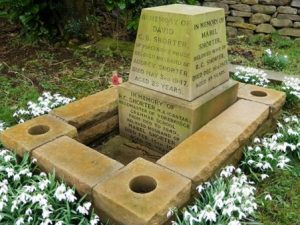
Rennie died in 1956 and his wife in 1973 and a memorial to them and their children stands in Bainbridge cemetery.
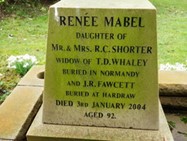
David’s sister, Renee had married Thomas Dawson Whaley in Askrigg in 1934 and they lived in Rookhurst in Gayle. Dawson, went to Yorebridge Grammar School, where he had met first met Renee. He trained as a solicitor and was working in Romford, Essex when they married. They lived for a while in Newport, in Shropshire where their daughter Greta was born. Dawson was in the territorial army and joined up when war was declared. He
obtained his commission in the Royal Artillery and was stationed in Northern Ireland. Renee moved to be close by and their son, Thomas was born during this time. Dawson began training for the Normandy landings and was based in the south of England, so Renee, heavily pregnant, took the children home to Rookhurst. Dawson died on 17th July 1944 when acting as a forward observer - he was shelled by Panzer artillery and strafed by the Luftwaffe.
Renee gave birth to a second son, David, a week after Dawson’s death. She married John Fawcett in 1948 and lived in Wensleydale until her death in 2004.
Josiah Stevens was born in Nottinghamshire in the 1880s and was a carpenter and joiner. He married Annie Holmes on 20th February 1909 and six months later their only daughter was born. The couple then had a son, Reginald, who was born on 2nd November 1912, but Annie never recovered from the birth and died two weeks’ later. His young children were looked after by Josiah’s family when he enlisted in the Royal Engineers in 1915, leaving the service at the end of the war as a corporal.
On 25th May 1919, Josiah married Lily Bettison, a 25-year-old schoolteacher from Belper in Derbyshire. In November, Lily gave birth to a son, Ernest Keith, more usually known as Keith. The family moved to the Dales in the 1930s when Lily took up a position as teacher at Bainbridge School. In the 1939 census, the family was living in Bowbridge, just outside Askrigg on the Hawes Road. By then, Reginald, a joiner like his father had brought Winifred, his bride to join the household.
The family quickly settled into life in Askrigg. Josiah had his own carpentry business and helped with the choir at St Oswald’s. During the Silver Jubilee celebrations at Bainbridge in 1935, he was the leader of the band that led the procession. Keith worked at Swain’s shop in Hawes and amongst his friends was Jack Hindle, another name on the WW2 memorial.
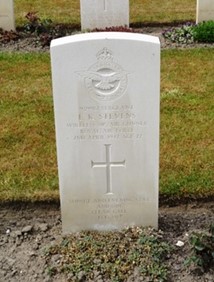
When war was declared, Keith joined the Royal Air Force Volunteer Reserve and was soon training as a wireless operator and air gunner. He was a member of 214 squadron, based at RAF Stradishall in Suffolk and was flying in Wellington bombers. The bombers from Stradishall were flying missions mainly against naval and industrial targets in Western Europe.
On the night of 1st April 1942, 14 Wellingtons from 214 Squadron and 21 other Wellingtons joined 14 Hamptons to carry out a low-level attack on railway targets at Hanau Lohr, near Frankfurt. Their approach was met with heavy flak and from German fighter squadrons and 214 squadron returned to base having lost half of their bombers.
Wellington Z8805, a Mk1C, was flown by Sergeant Eric Dixon and Pilot Officer Thomas Best, with observer Sergeant Albert Richards, Wireless Operators/air gunners Keith and Pilot Officer James Henderson along with Gunner Sergeant Edward Albrighton. The aircraft was brought down by flak from no 7 Flak-Division just south of Cologne, close to the Rhein at Lulsdorf-Neiderkassel and the subsequent crash killed all on board outright. The crew are all buried in the Rheinberg War Cemetery in Germany.
Josiah and Lily moved away to Kent at the end of the war.
‘It is with the deepest sympathy that I write to tell you of the death in action of your charming boy, who was my intelligence officer. A braver, cooler and more reliable officer could not be found. He had done wonderfully gallant work on patrol on numerous occasions and whatever the job he had to do, I could absolutely rely on his doing it thoroughly. I know no other officer in the Battalion I could have spared less than he. He was brave as a lion. We were counter-attacked at 4.30am on 24th and I turned out all the men at HQ. He, without any orders, dashed off with the leading men right up to the front where danger threatened. I don’t know how I shall replace him as not only was he valuable as an officer, but I was very fond of him, as were we all.’
He was mentioned by Sir Douglas Haig in dispatches for his gallant and distinguished service.
Second Lieutenant Bernard Grime Lodge is commemorated both here, and at the Tynecot Memorial in Flanders (panel 28).
Bernard’s cousins John and James Preston, sons of Sarah’s brother James, were also both involved in WW1. Whilst John survived and returned to his wife Lizzie (who was also a cousin of Bernard and John through Sarah and James’ sister Margaret!) his younger brother, James, died just over a week after Bernard following wounds sustained in battle aged just 20.