History of our Church
 There will have been a Chapel of Ease on this site for at least 500 years to serve travellers and lay brothers moving their sheep from Jerveaux Abbey to their grazing grounds. The first Curate for Hardraw was licensed in 1686 and this old church lasted another 200 years until the present church was built in 1879/80 with funds provided by Lord Wherncliffe, who had his hunting lodge at what is now Simonstone Hall Hotel.
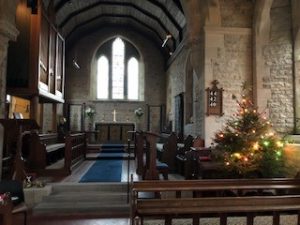
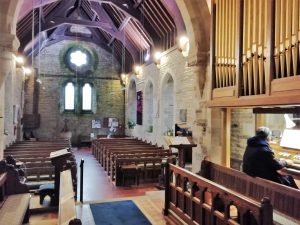
The church is built of simple dressed stone with a stone flagged roof. The chancel and central isle in the naïve are flagged and clear glass in the windows let in a good light. The stained glass windows on the South side of the Chancel are beautiful with the sun shimmering through. They were provided by the Rev Robert Pinck who was vicar of Hardraw for 59 years, dying in 1913. One window celebrates his first 25 years at the church and the other is a memorial to his eldest son who was drowned whilst at Sedburgh School.
The History of St Mary and St John’s booklet is found at the rear of the church and transcribed below.
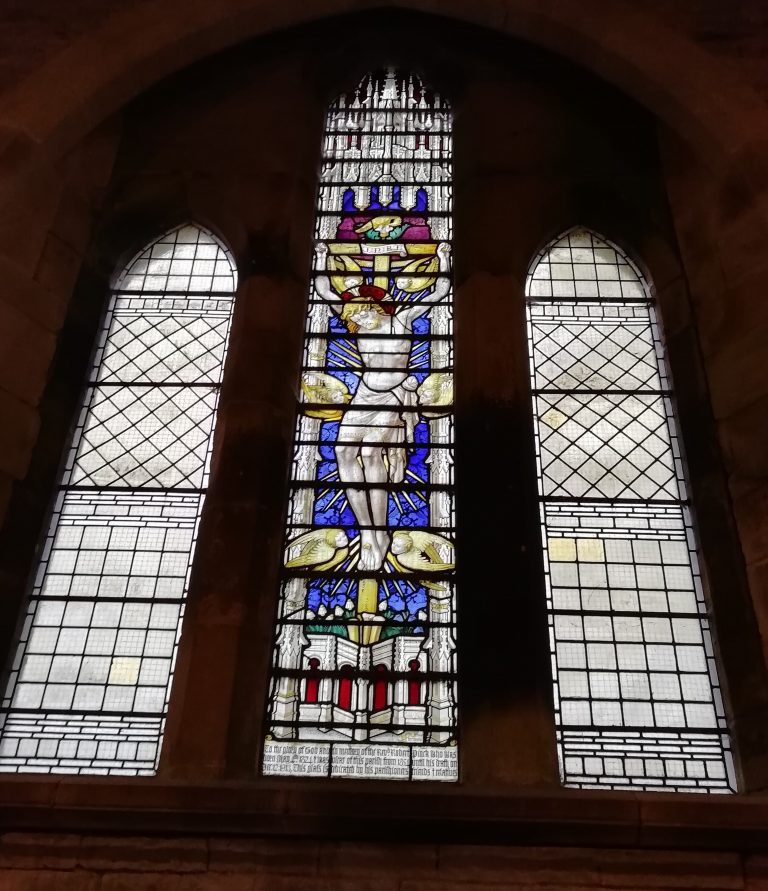 The magnificent depiction of the Crucifiction in the East window was provided by the parishoners in memory of the Rev Pinck and designed by Sir Ninian Comper.
Its beauty is in its simplicity.
The Crucifixion of Jesus is central to our faith. In this important act in history, God showed his love for us in that he let his son, Jesus, take the punishment for our sin. By doing this, he opened the way for us to become part of his family – adopted as his children.
‘For God loved the world so much that he gave his only Son, so that everyone who believes in him, may not die but have eternal life’
John 3 v 16 GNB
The story doesn’t finish here. God raised Jesus from the dead and in doing so showed his victory over death. We can live in this victory.
Jesus said ‘ I am the resurrection and the life. Those who believe in me will live, even though they die, and those who live and believe in me will never die’
John 11 v 25, 26 GNB
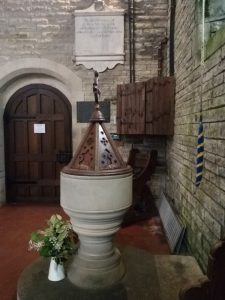
A Brief History & Guide to St. Mary & St. John's, Hardraw
Written by Trevor Johnson
2019 Copyright Hardraw PCC and Author
The Village of Hardraw
Hardraw is Old English for shepherd's dwelling. Our village has three claims to fame. First comes Hardraw Force, accessible via the Green Dragon pub, and painted by J.M. W. Turner, where Hearne Beck plunges nearly a hundred feet into the deep ghyll below. Second are the open-air brass band concerts held here from around 1884, and recently revived. In their heyday, great crowds of competitors and spectators drove up from Hawes railway station for 6d each. Lastly- though now all but forgotten - the Hardraw stone slabs formerly quarried here were reputedly the finest available.
The Pre-Reformation Church
Prior to King Henry VIll's Act of Supremacy of 1535, the few and scattered people of Upper Wensleydale had their spiritual needs catered for by visiting priests from the great Cistercian Abbey of Jervaulx, which had come to own nearly all the land in the upper dale north of the River Ure. Traditionally, the monks kept a small chantry chapel in Hardraw; (they certainly had a grange i.e. a farming outpost here.) Besides the Mass they may have performed occasional weddings and baptisms too. But there was no proper church nearer than St. Oswald's, at Askrigg, several miles away.
The Post-Reformation Church.
After Thomas Cromwell's ruthless dissolution of the monasteries (1535-9) and the tragic outcome of the Pilgrimage of Grace which led to many local deaths including the hanging of Jervaulx's Abbot at Tyburn, religious provision in Wensleydale was in disarray. St. Andrew's church at Aysgarth, a Norman foundation, became 'mother church' of the entire upper dale, sharing with Askrigg the right to tithe their - by now large and unwieldy - parishes. By slow degrees growth in population, and the people's well-founded complaints about difficulties of travel, led to the setting up of chapels-of-ease (i.e to ease church-going) in outlying villages from the late C16 onwards. One was built at Hawes and another here. [See end-note].
The First Church Building 17th century
We cannot date the first building at all precisely, nor does any picture of it survive. It will certainly have been similar to the simple "barn-church', at Lunds, nearby. It was, as many were, white-washed annually. However, set into the wall of the vestry is an informative plaque, which was evidently removed from the old church and transferred here during the building of the new one. The lettering is incised into what appears to be slate and was probably either gilded or picked out in black. But the colour has faded to near-illegibility in places. So, because it has such an important bearing on the history of the church it is transcribed in full below:
A.D. 1717, 1752, 1757, 1760
The Ch [urch] of Hardraw was
augmented with £1200
A.D. 1758, 1760 Laid out in lands
whereof given by Queen Anne's bounty* £800
The Hon. Edward Wortley Esq. £200
Exec[utors] of W'm Stratford LL.D £100
Another benefaction £100
With another grant, 1820 of £100
* Queen Anne's Bounty. In 1704 Queen Anne set up a fund to receive the tithes and annates Henry VIII had confiscated from the church. These were now re-directed to augment the livings of poor clergy and later to the repair of churches and parsonages by gift or by loan. From 1948 the newly formed Church Commissioners took over these funds and their management.
Evidently there was a church here before 1717 and, it is fair to assume, one built in the 17th century, since we know that by 1763 the church was described as 'ruinous'. As both Hawes and the yet more sparsely populated Lunds had 'chapels' in the early 17th Century a date of between 1630-50 would be plausible for Hardraw. It isn't clear exactly who gave when, but it looks as if the opening series of dates must refer to the various benefactions, totalling €1,200, which were used to purchase land in the locality, presumably in order to lease it or rent it to farmers and so obtain some income for repairs etc.
Early Parish Clergy
For the first hundred years or so there will certainly have been no permanent priest. Chapels of ease were served, when they were served at all, by 'Assistant curates' appointed by and subject to their Vicars, in this instance the Vicar of Askrigg who would have paid them largely out of his own stipend and probably very little. There wasn't even a rent-free 'glebe house' [parsonage] as far as we know. So, with no incentive to reside in Hardraw, 17th and early 18th Century assistant curates will have been mere birds of passage. Indeed, because the extant Askrigg Registers from the 1670's onwards record Hardraw folk as still being baptised, married and buried at St. Oswald's, it looks very much as if Hardraw chapel had little standing in the 17th and early 18th Century. It will simply have had Morning Prayer {Matins} on Sundays, with Holy Communion - as was anyway the general custom then - only at the great Festivals of Christmas and Easter with maybe Whitsuntide and one or two other occasions also.
The Eighteenth Century Church
The mid-eighteenth century saw some striking improvements. To begin with, the survival of Hardraw's own Chapel Register from 1750 which covers an area including the hamlets of Sedbusk and Simonstone, Litherscue and Fossdale, all previously only recorded by Askrigg, proves that there was now a permanent (and presumably resident) 'Minister' with - in effect - a 'parish' of his own. The Register, for its initial entry records the death of a J.Metcalfe of Cotterdale 24 May 1750. It is written in the singularly beautiful copperplate hand of the Rev'd Richard Fawcett, just appointed as 'Perpetual Curate' of Hardraw. [A 'perpetual Curate' as opposed to an 'assistant Curate' had what we would call tenure]. Since a Mr. J. Calvert appears beside him as 'Chapel Warden' it is safe to say that the 'parish' now enjoyed a fair measure of autonomy. Both men bore what were - and still are - very familiar local surnames, and they obtained many signatures on their 1763 petition to the Archdeacon of Richmond, requesting that urgent attention be given to the need for a new church. The petition contends that the old one is not only 'too small for our needs' but also "in a very ruinous condition'. Some funds were offered, including €100 from the Countess of Bute, and the various donations listed on the tablet transcribed above must have originated in this appeal. However there is no evidence at all to suggest that a new church was actually built, though it is quite likely that the old one was renovated and perhaps even enlarged.. The Yorkshire Post's fascinating account of the laying of the foundation stone of this church in 1879 says that 'the original structure was built around 1748-49' but that seems to be hearsay and makes no sense in view of the 1763 petition. Who on earth would claim that a church was ‘ruinous' only twenty years after it had been built?
The Rev'd Richard Fawcett, Perpetual Curate
Although it seems he failed to get his new church Richard Fawcett appears to have been happy to stay on here, in what was very probably his home dale. There were compensations. He found one in a local girl, Martha Harrison from Sedbusk. His own Register records their marriage in 1770, the births of their four children 1771-79 and finally his own death in1795. That entry was made and witnessed by his 'Assistant Curate at the Chapel' the Rev'd Watson Moore (yet another local name) who duly succeeded him, and then married a Margaret Fawcett the next year, the ceremony witnessed by Edward Fawcett. Since these are the names of two of Richard Fawcett's children, it looks as if Moore married his boss's daughter, doesn't it? The Moores had two children, but his entries cease after 1809 when, presumably, he moved elsewhere, perhaps promoted. But something like a dynasty had begun to take shape. For now, the Rev'd Edward Fawcett - surely following in his father's footsteps - takes over for the next quarter of a century. Throughout his period of office Hardraw and Sedbusk prospered, relatively speaking, as coal-mining at West Pits and stone quarrying grew apace. Many workers, some pretty rough diamonds, moved into the area. Baptismal and marriage records show a rapid growth in population, but burials a heart-breakingly high incidence of infant mortality. And after Edward Fawcett's rather early death in1834, the Rev'd Henry Scabler took his place, just three years before Queen Victoria came to the throne. Of all these obscure clergy, toiling away in what was then one of the remotest corners of England, we might say with Ecclesiastes:
And some there be that have no memorial;
they are perished as though they had never been...
But these were merciful men, whose righteousness
hath not been forgotten...
The Victorian Church
We move on into the 19th Century when, after the defeat of Napoleon at Waterloo in 1815, the Church of England at last began to stir from its long drowse, prompted from within by the Oxford (or Tractarian) movement and from without by the unprecedented growth of non-conformism as the legal barriers which had shackled it were one by one dismantled. Methodism in particular ran like wildfire through the Dales, where the people had never lost their habit of stubborn independence. Chapels sprang up in nearly every village, at Hawes, at Gayle and even at nearby Sedbusk. Many new Church of England places of worship were also built at this time, initially to serve the teeming towns of the Industrial Revolution, but subsequently in rural areas too. From 1811 onwards the Church's National Society was fast erecting schools, and the thorny question of clergy incomes was at last tackled when Pluralism was abolished (i.e. the right of one clergyman to hold two or more benefices simultaneously). Clergy stipends were still far from equal, but the most glaring injustices were alleviated. Across the river a mile away, Hawes built its fine new church of St. Margaret's in 1852. Finally in 1868, "perpetual curates' disappeared forever, and all incumbents became either Vicars or Rectors of their parishes. All these changes were soon to affect Hardraw.
Enter the Reverend Robert Pinck
When Henry Scabler left in 1854 his place was taken by a young Oxford graduate aged 30, initially inducted as Perpetual Curate of Hardraw and Lunds' (whose tiny and now derelict church still stands a few miles away, just off the Kirkby Stephen road – SD79373 94564 * Ed Note - see page and photographs of Lunds church on the St Margaret's pages of this website) Under his obviously vigorous sway one might say that things began to hum! Many new names of 'Chapel Wardens' appear, and services become more frequent. Yet more births are noted, some harshly recorded as 'natural' or, even worse, "reputed' sons and daughters. By then Hardraw had the unwelcome addition of a 'workhouse' and burials of its 'paupers' begin to appear. It was no golden age. Pinck, as the 1861 Census tells us, lived initially as co-tenant of Rigg House, which is an imposing bow-windowed Georgian building on the Kirkby Stephen road (Near Cotterdale), little changed today. At first he had briefly lodged with his wife in Gayle, where a son, Charles Henry, was born, and he must have had private means because we later find him as owner and landlord of cottages in Sedbusk. But, more to the point, he must soon have become liked as well as respected, because a new 'parsonage house' was built "by public subscription' in 1864 by the Earl of Wharncliffe, whose 'hunting-lodge', off the Muker Road, on the way to Buttertubs Pass, is now the Simonstone Hall Country House Hotel. The Vicar of Hardraw, as Pinck became in 1868, certainly needed his new vicarage to house his wife Phoebe and their four sons, aged between 4 and 13. For the 1871 Census tells us that, by then, two more sons had been born besides - no doubt to the Pincks' delight - a daughter, Phoebe Sarah. She, incidentally, at the age of 32, was to be married from the Vicarage, to a 'wine-merchant' from Staffordshire, aged 44! Such inscrutable scraps from the past are fascinating by-products of the old Registers. But in 1865 her parents had suffered a tragic loss when their eldest son Robert had been accidentally drowned at Sedbergh School, where he was Head Boy. It was to Robert's memory that the Vicar dedicated one of the pair of stained-glass windows he presented to the church. The other commemorates his own 25 years of service here.
All the evidence suggests that, since his arrival, the church had grown and prospered steadily, as it continued to do. To move forward for a moment, when in 1912 he signed his last Vestry Minutes, he had become the patriarchal figure as his portrait shows - bearded like an Old Testament prophet. He was eighty-eight years old and had seen the deaths of both the old Queen - crowned when he was twelve - and her son Edward VII. What tales he might have told on the eve of the First World War, when the rural world he had known was to vanish forever in the appalling carnage of the Western Front 1914-18. Perhaps happily for him, he did not see it, dying in 1913. Among his happier memories must have been the day in 1878 when he had written joyfully to a friend;
We are going to have a new church at Hardraw...
Lord Wharncliffe is going to build it and the cost
is estimated at £1,200-1,300 ... it will take 12 to 15
months to build.
A bronze plaque which records the Earl's munificence includes a dedication to his dead brother. The Vicar's young daughter, Phoebe, it is pleasant to record, laid the foundation stone on 17 May 1879. Beneath it the Vicar himself placed a bottle (containing what we should nowadays call a time-capsule, with newspapers, signatures, coins, etc) How we should like to open it now! Prior to the service of dedication, conducted by the Bishop, the Yorkshire Post (17 May 1879) records that:
The scholars, teachers and church-wardens met
at the ... school, and marched in procession
through the village, singing an appropriate hymn.
Afterwards, it continues
... the whole party repaired to the Green Dragon
Hotel, where a sumptuous knife-and-fork tea was
prepared for those present.
A 'sumptuous knife-and-fork tea' - that long-dead journalist's phrase still makes the mouth water. doesn't it?
He concludes:
The Church was dedicated to Saint Mary and Saint
John. The old church does not seem to have had a
[patronal] name. (It was always simply "T' chapel')
The final cost worked out at some £3,500; double the original estimate, a phenomenon with which we are still familiar today!
The Present Building
Architecturally, the church is a rather attractive mixture of styles. It was designed by the fashionable London architect R. H. Carpenter, in what has been called a 'muscular Gothic' manner. Thus the 'plate tracery' headed and quatre foiled nave windows are Romanesque in origin (i.e 12th Century) while the lancet windows are Early English (i.e 13-14th Century) and the barrel-vaulted roof perhaps Saxon (pre-1066). Both materials and workmanship are of the very highest quality, with costly ashlared stone throughout and tiled floors. A fine Jacobean oak screen masks off the Vestry. The builders were local men, Dinsdale and Fothergill of Hawes, whose work has stood up sturdily to the harsh winters of the upper dale for well over a century. And there it still stands, by the old bridge, the river lapping against the churchyard, in one of the most tranquil settings imaginable, perfect for a May wedding or a frosty Christmas morning service.
Inside, easily the most striking feature is the superb, glowing east window, over the altar and depicting the Crucifixion of Our Lord. This is the work of Sir Ninian Comper (1864-1960), the foremost English church interior designer of his day, also responsible for the splendid, gilded reredos at nearby Ripon Cathedral. It was installed to commemorate the long and devoted service of old Rev'd Robert Pinck, whose death on 13 December 1913 marked the end of an era. A Vestry Meeting held early in 1914 originally commissioned it to depict the Good Shepherd, but they altered the theme later to the Crucifixion. With hindsight we can see their change of subject as all too sadly prophetic. If we think of this tiny community's loss of seven men and remember that a further forty died in neighbouring Hawes, and yet more from nearby hamlets, we can see what an appallingly high proportion of the adult male population was killed. Many more would have been gravely wounded.
The Twentieth Century
After Pinck other Vicars came and went more swiftly until, the population having dwindled, the school closed, and the shop gone, as in so many of our smaller villages since the last war, the church lost its autonomy and became a joint benefice with St. Margaret's, Hawes, sharing the services of its Vicar. But Holy Communion is still celebrated at St. Mary and St. John every Sunday morning, there is a Midnight Eucharist on Christmas Eve, and, when it is the turn of Hardraw for the Christmas morning service you will have to come early to get a seat. On the first Sunday of the month there is a special service for children followed by a shortened Holy Communion.
In 2007 a pipe organ from a redundant chapel down dale was installed in the church to replace the small harmonium in use since 1902. The Pennine Way runs right past the door and many walkers look in, attracted by the aura of peace that the church breathes. As churches go, ours is not particularly ancient, nor - unlike some other Victorian examples - is it large and pretentious. Nevertheless, here at all seasons one is reminded of Siegfried Sassoon's lines:
Above the voiceful windings of a river,
An old green slab of simply graven stone
Shuns notice, overshadowed by a yew ...
Sassoon was writing of the 17th Century poet Henry Vaughan's grave in the Usk valley, but today we may muse for a moment on old Robert Pinck, and his 18th Century predecessor Richard Fawcett, on their families who grew up here, on their now mostly nameless congregations who lie quietly under the churchyard's turf, on those who toiled to build their first little church here some four centuries ago, and - still further back in time – those Cistercian monks and lay brothers of nearby Fors Abbey (fors = waterfall) who, though they soon moved to Jervaulx, tended their flocks – woolly and human alike - here in King Stephen's reign during the early 11th Century. Of them all in their day we might say - and pray it may be true of ourselves - quoting Sassoon's words again
Here faith and mercy, wisdom and fumility
Whose influence shall prevail for evermore,
Shine...
The Parish Records: a few samples
1874 To whitewashing the [old] church 10 shillings
1874 Half a gallon of Port [i.e. communion] wine 9 shillings!
1876 10 roods of stone walling to enclose the new burial ground £10 17s 6d (i.e. to enclose 2.5 acres)
1881 Furniture for the [new] church £18 11s 3d (most of this is still in use today
1884 Band Concert in the church, receipts £10.00 (a good sum for the day: the church must have been packed)
1886 Donated by organisers of [open air] Band Concert £10.00
1900 Insurance for church and chancel 15 shillings & 3 pence (this is the first mention of any insurance)
1900 Sunday School picnic 16 shillings (probably a trip in horse-drawn vehicles)
1902 New organ given by Lord Wharncliffe
1902 Mr. R. Waggett employed as Sexton, to be paid £7.10s per annum, increasing to £8.10s (he will have had other work)
1917 Roll of Honour, France 16 shillings [it was, alas, provisional]
1929 Diocesan Quota £5.00 (a rather unwelcome innovation)
End Note, First known reference to Hardraw Church.
The diary of Dr. Thomas Cartwright, Bishop of Chester (of whose Diocese Hardraw long formed part has this entry for 19 December 1686 "My son, Mr. John Cartwright [was] preacher in the Cathedral, after which I ordained [list of ordinands follows] I gave licence the same day to John Thomson to be curate of the chapel of Hardraw in [the parish of] Aysgarth'. This firmly dates the first church to the 17th Century and also gives us the first Hardraw curate known to us by name.